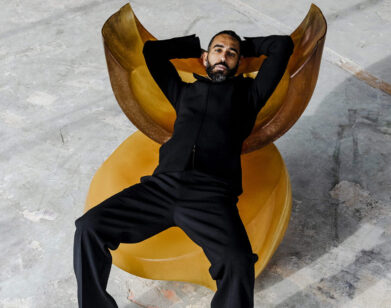



James Jebbia is Supreme


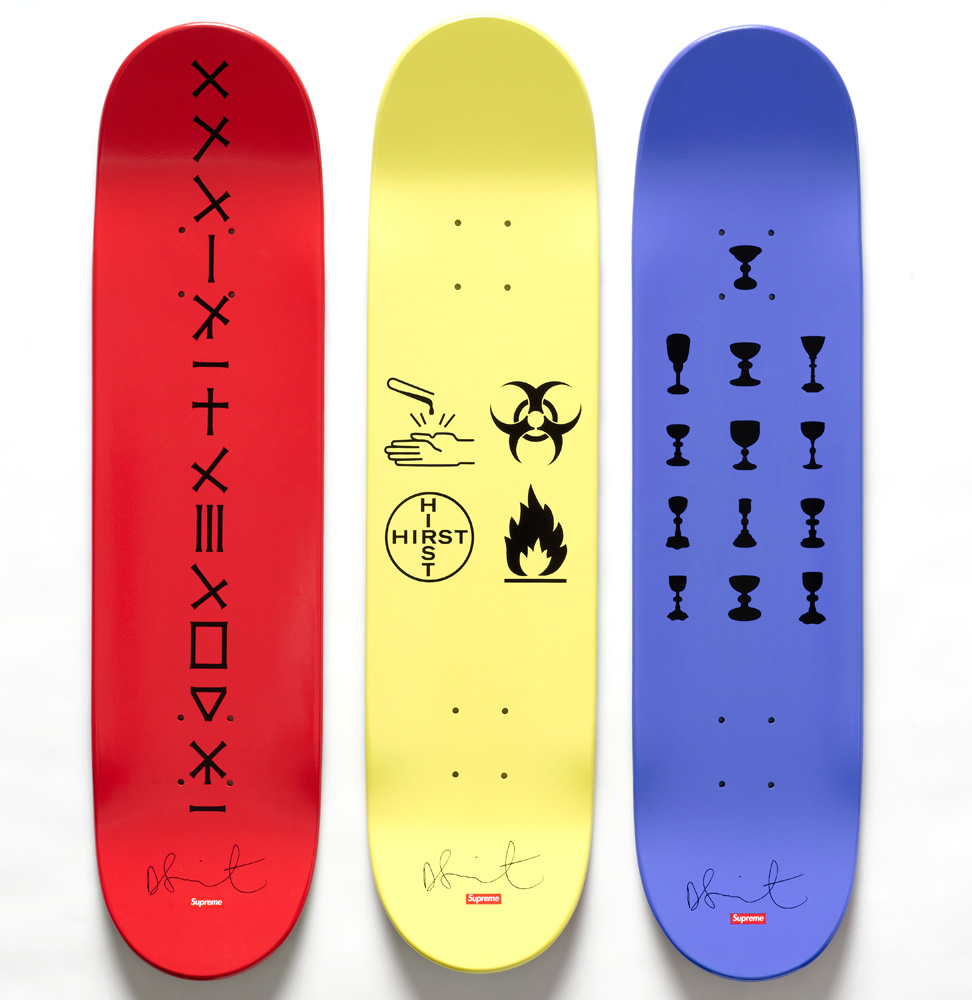
Supreme is a different sort of fashion company. Some people would call Supreme street fashion, some would call it skater fashion, but really it’s beyond classification. They make clothes and accessories, but they also make skateboards, and the skateboards are collected like art. In fact, they’ve put out skateboard decks by artists such as Larry Clark, Jeff Koons, Richard Prince, Christopher Wool, Nate Lowman, and most recently, Damien Hirst. Their shoes and other products are collected as fanatically as art. Sometimes when a new item comes in, customers line up on the sidewalk for 24 hours, sleeping on the street to be among the lucky few who are able to buy it—there’s a big secondary market for Supreme stuff, in part because it is produced in only very small quantities, but also because Supreme has just two shops in the U.S. (one in New York and one in L.A.), five in Japan, and they sell to a very limited number of other stores, like Hide Out in London and Colette in Paris.
Supreme’s founder James Jebbia was in on the first wave of skater fashion, partnering with Sean Stüssy. When Stüssy left the business, Jebbia opened up Supreme in 1994 in a small storefront on Lafayette Street in downtown New York. Fifteen years later, Supreme is at the pinnacle of populist youth fashion. It’s as big as it wants to be in New York and L.A. and huge in Japan. It’s got a renegade eye, outlaw good taste, and a sort of cult following that lives on the razor’s edge of fashion, art, and sport.
GLENN O’BRIEN: So how is the recession treating you?
JAMES JEBBIA: Our business is really good. We didn’t plan for a financial crisis, but we were
already working hard, trying to make really good product, and we’ve always tried to keep our prices as reasonable as we can.
GO: We’re seeing an interesting moment in the marketplace. I think it’s a time for new values. I think some of these empty luxury brands are going to disappear.
JJ: I agree. I don’t wish for anybody to go out of business, but I think there are far too many things in New York that really shouldn’t be here. I’ve been doing what I’ve been doing for more than 20 years, so three or four times I’ve been through things where it’s like, “Wow, it’s a tough time.” Ever since September 11, I’ve been quite conservative in what we’ve ordered. We’ve never really been supply-demand anyway. It’s not like when we’re making something, we make only six of them. But if we can sell 600, I make 400. We’ve always been like that—at least for the past seven or eight years. For every season, we put in a lot of work to try to create exciting stuff. So it’s not like in these difficult times we’re going to suddenly pull up our socks—we’ve always been busting our asses every single day to try to get it right.
GO: Was it like that in the beginning?
JJ: Not really. We opened in 1994—
GO: That was during an economic downturn, right?
JJ: Yeah, but we did good in that environment . . . It was really a different time. I had the Stüssy store right here on Prince Street, but Sean Stüssy, the designer, didn’t know whether he was going to do it for that long. He’d made a ton of money, and then I think he decided to retire. So I thought, Shit, I’d better be doing something else, too, because I don’t want to count on this. I’d always loved what went on in skateboarding. I’d never skated myself, but I loved the graphics—I really liked the rebelliousness of it. And a lot of kids who worked for me skated, but it seemed to me that there were no skate shops around. So I was like, “Okay, cool, maybe I’ll do a skate shop.” It cost me, like, $12,000 to open the store. Rent was two grand. It was like, “Hey, if we do five grand a week, then great!” We didn’t really do any business at first, but we did okay. I really liked all of the hard goods—the decks, the wheels, the trucks. But all of the clothing that the skate companies put out was crap. These companies had to sell to a wide range of people, and a lot of them were very young. When people think of skaters, they think of, like, the 12- or 13- or 14-year-old kid. But in New York, it was the 18-to-24-year-old hardcore kid who wasn’t wearing any skate stuff. They’d wear a hat or whatever, but they wouldn’t wear the clothing,because it would fit badly and was bad quality, and skaters want to look good and pick up girls. So we slowly started making our own stuff. It was a time when it was a lot easier to do that kind of thing. It was easier to make a sweatshirt in Brooklyn, or do these hats locally, because you could get nice things made fairly easily. And because we didn’t have to worry about appeasing a 14-year-old kid in a mall, we spent a lot of time trying to make the right stuff. We didn’t dumb it down—we only made things that we really liked. I feel like kids in New York appreciated that, and after a while we got a bit of a following in Japan and in Europe, and we’ve just kind of done it the same ever since. We’ve kept on that same mission of just being a small company, but really trying to make our product as good as anybody else’s and concentrating on what we can do well. That’s why I’ve appreciated you as a customer. A lot of people dismiss what we do. They think, Well, it’s skate, so it’s got to be, like, big baggy pants, cap backwards, big chain . . . They don’t understand that just because skating is the culture we’re working in, it doesn’t mean that we can’t make good things.GO: Well, I stopped in eventually because I was in the neighborhood. I’m probably the age of your customers’ fathers and I must have walked by Supreme a thousand times before I ever walked in. But I guess I saw something in the window and I thought, “Gee, that looks good. Maybe I’ll go look at that.” Then I immediately realized that both the quality and the concept were great. The khakis or the jeans that I have from you is stuff where I’m like, “Why didn’t I buy three pairs?” A.P.C. is also like that—there’s an independent mentality.
JJ: Definitely. I feel like A.P.C. has done a great job of really sticking to what they do. They keep an eye on what’s going on in fashion, but it’s always rooted in a ’60s kind of French style. Our stuff is pretty similar each season, but we keep an eye on what’s going on, and it’s always fresh, and there’s always, I think, a sense of the early ’90s to it. That era is definitely a big influence running through everything we do—that was a really special time. And since we started back then, I think it’s fine for us to always look to that era and get a lot of influence from it. It’s not nostalgic—it’s more like it’s a part of us.
GO: How did the name come about?
JJ: Supreme wasn’t meant to be a brand. I just was like, “Hey, that’s a cool name for a store.” But it’s become a problem since it’s become a brand because we don’t own the name. It’s a good name, but it’s a difficult one to trademark.
GO: Interview is kind of like that. Somebody has an Interview out in Russia now. But you also have a great logo, so that probably makes it easier in a way.
JJ: Yeah, it does. That kind of thing used to bug me more. I know there are other Supreme shops in other countries, but after a while, people know what the real thing is. With Supreme, there were no grand plans—with the name, with the store, with anything. It all just evolved. These days, it’s a lot more difficult to do that. You’ve got to come out with all guns blazing right away or you don’t stand a chance. Whereas when we first started, there weren’t blogs ready to shoot us down the day we opened. We were given time to make mistakes and grow.
GO: How did you get big in Japan? Was it Japanese kids coming here and then taking stuff back with them?
JJ: Yeah. Do you go to Japan much?
GO: I used to go a lot. I’m dying to go back.
JJ: I go maybe once a year and I always get inspired. I think what happened was, right when we were starting, there was a little scene building up in Japan. There were a few new Japanese brands starting up for young people. Now, they don’t need any more product out there, but if it’s something that’s legitimate, then I think they’re very keen to embrace it. So our eyes were never on Japan. It was more like—
GO: They found you.
JJ: Yeah. We never pandered to the Japanese customer. We still don’t. It’s more like we’re just trying to make stuff for that real pain-in-the-ass, picky New York kid. And I think that the kids in Japan could see that and say, “Okay, yeah, that’s legit. There’s nothing else quite like that going on.”
GO: Japanese connoisseurship is so interesting. There’s this great, educated taste. Last night, I was lying in bed with my wife, watching the football game. She was on her laptop and she said, “The Japanese are ruining the ceramics market!” I said, “What?” She’s really into modern design, and I guess a lot of the modernist stuff she collects has gone through the roof because the Japanese are buying it now. She said, “Our plates have gone up five times in price!”
JJ: What I find in Japan is that there are certain people who have a lot of influence. So if there’s somebody, say, like, Nigo or Hiroshi [Fujiwara] . . . This isn’t dropping names, but if those guys are into, like, [Jean] Prouvé furniture, then it’s going to become popular. They
really do have people there who influence society, and if those people deem that they love something, then it becomes this big thing. These Japanese collectors know what they’re buying, though, from denim to records to stereo equipment . . . They’re very smart.
GO: When did you start doing your own skateboard decks?
JJ: We started doing decks probably around 1997, but more the logo kinds of ones. Maybe once a year we’d do something—no big deal. Then we started doing more around maybe 2000 or something.
GO: Who was the first artist you worked with?
JJ: The first actual artist was Rammellzee.
GO: Was he difficult to work with?
JJ: He was actually one of the easiest people to work with.
GO: Really?
JJ: Yeah. I had him do these pieces in the store. It was very much like, “This is the money I want and I’ll do it.” He was very much like that. Rammellzee is not politically correct. When he comes into the office, he’s a bit crazy and the girls are a bit scared of him . . . [laughs] But I think his decks were the first decks that we did. Then from there we did something with Ryan McGinness and then with Kaws. But I think what really got attention was when we did those Larry Clark decks. What’s important for us is the kid who comes into the store. It’s actually easier to get the art crowd, because they’ll buy anything if they think they can make money off of it. But for us, it’s not good if a kid doesn’t look at it and say, “I don’t know what the fuck that is or who did it, but that’s really cool.” Larry’s decks, I feel, were very much like that. We got both audiences into them. Then Jeff Koons saw the deck that Larry did and liked it, and he did some decks for us, which was really cool. Jeff was as easy to work with as anybody that we’ve worked with—he was just as into it. I really appreciated that he cared that young people liked them and that they looked good. He wasn’t tormented. He didn’t drive us nuts. It wasn’t like some rarefied experience. Since then, that’s really been our approach. Working with these artists is quite a simple process for us: We don’t make a big deal of it, they don’t either, and I think that’s kind of why it works.GO: One of the great things about Jeff is that he has the original spirit of Pop art. Pop art was supposed to change the world, and then it got sort of co-opted by the market. But it’s great when artists make product that gets out there to lots of people.
JJ: There have been a couple of artists who we’ve thought it would be good to work with, and then they’re like, “I can’t have my artwork on a skateboard.” But I don’t think somebody like Jeff needs to worry about his place in the art world. Now when we work with people, it’s because they get a kick out of it more than anything else. It’s as simple as that. Nobody’s making a ton of money off of it.
GO: I’m friends with Christopher Wool, and he can get a little tortured because he’s a perfectionist. I said, “I really like the decks you did.” He said, “Yeah, but the brown one isn’t the right color. It doesn’t look enough like shit!”
JJ: [laughs] Again, Christopher was quite easy to work with. I wish we could have done the text ones, but he didn’t want to do them. But while it’s important for us to work with these big artists, it’s just as important to us to work with people who nobody knows. It’s just as important when somebody sends us something like a graphic or whatever, and we think, Wow, that’s great. We’ve got to keep our balance because we don’t want it to be like, “Oh, they’re just doing this high-end stuff.” I feel the reason that we get to work with a lot of people is because it is a street-level kind of thing. And we don’t number these things, but they are of a limited run. It’s funny, because we often get these art people who come in and get really mad when we don’t tell them the edition . . . They get really pissed. It’s like, “Look, it’s 68 fuckin’ dollars. Don’t worry about the edition. If we really wanted to do that, we’d be selling these for a thousand dollars. Buy it and like it and get the fuck out.” So it’s funny how some of the people who come in just don’t understand. We know we could sell these things for more, but we want young people to be able to buy them.
GO: But that happens with the shoes, too, when the kids are lined up around the block . . .
JJ: Yeah. But when we do a pair of sneakers, they’re never that limited—for us, at least. They’re limited to our stores, but I’m not into making six of something. If we’re doing a pair of sneakers and they’re 90 bucks, then, yeah, there are probably going to be 1,000 or 1,500 pairs. I hate things when they’re too precious. That’s why we never, ever classify our stuff as limited. Ever. In an ideal world for us, I look at it like the product sold out within two weeks. Ideally, we have it and it’s gone in two weeks and then it’s done.
GO: A lot of those kids must be selling the sneakers. I see them on eBay or whatever.
JJ: Yeah. But I just look at it like that’s what kids do nowadays. You get a lot of young people who will come and line up and sleep out overnight to buy something, and then they put it on eBay. If they’re hustling to make a hundred bucks, fine. I have no problem with it. I used to think more of it. But now I just think it’s no different than somebody going and checking out a blog or something. To be honest, I’d worry if that didn’t happen, because then it’d mean that people don’t like our product.
GO: I have some friends who collect sneakers, and they just keep them in the box. Do people actually wear them?
JJ: I think people do both. A lot of these sneaker collectors buy two pairs—they wear one pair and they save one pair. But that whole sneaker game has fizzled a bit in the last couple of years because the sneaker companies started to actually market to that customer and kind of ruined it. Before, it was a phenomenon. People would be collecting Jordans and all these unique pairs. But the sneaker companies started to look at it like, “That’s a customer we’ve got to go after,” and, as always happens, they kind of did it too much . . . And the customers aren’t dumb—after a while they say, “Hey, they’re just playing us.” So every single time we put out something new, I’m nervous. I’m never like, “Yeah, these are sold out.” I’m always nervous. Because you never know. We always try to make things as good as we can, but I never count on that. So when I do see a line in front of the store, I’m like, “Cool. People still like the stuff.”
GLENN O’BRIEN IS INTERVIEW’S EDITORIAL DIRECTOR.