


Hamish Bowles


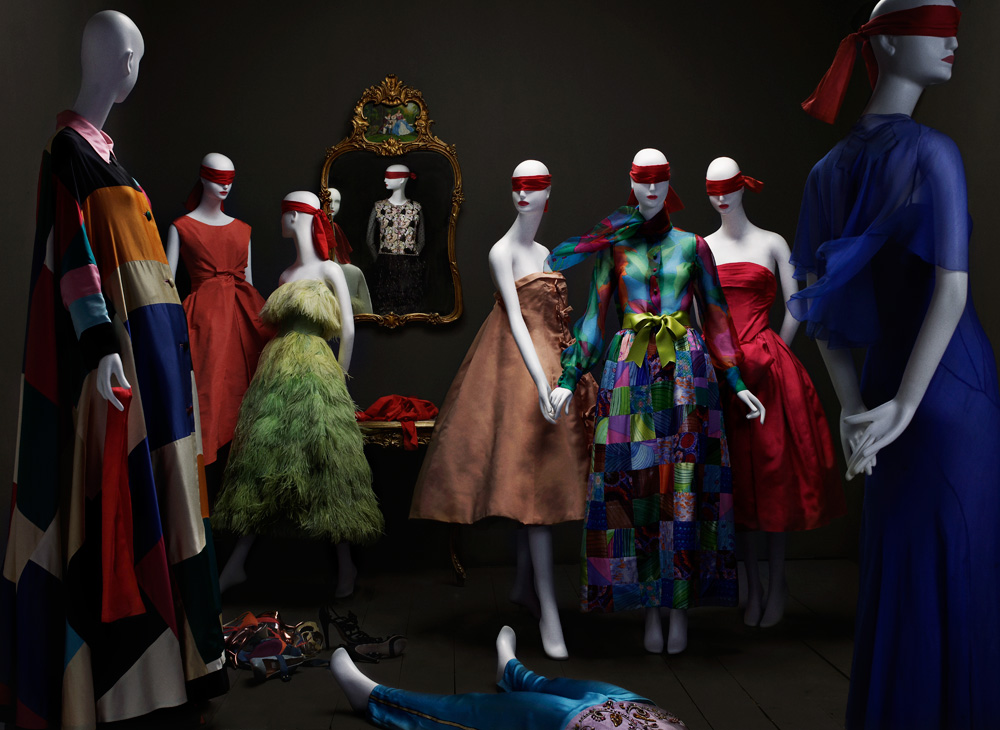
From Hamish Bowlesâ??s couture collection, from left: patchwork satin domino, Galanos, 1958; orange faille evening dress, Givenchy, 1960; chopped-green ostrich-feather evening dress, Scaasi, 1959; (reflected in mirror) embroidered point-dâ??esprit jacket and feather-trimmed skirt, Christian Lacroix, 1992; apricot faille Trapeze line evening dress, Yves Saint Laurent for Christian Dior, 1958; patchwork skirt and printed organza blouse and scarf, Yves Saint Laurent, 1969; Cerise faille evening dress, Christian Dior, 1956; chiffon dress over satin slip with matching cape, Mainbocher, 1932. Bottom center: embroidered moiré evening dress and satin pants, Emanuel Ungaro, 1984.
Hamish Bowles is not of the opinion that fashion is best appreciated on a short-term memory. For more than 30 years, the British style maharishi and longtime European editor at large at American Vogue has been amassing one of the richest andrarest collections of couture on the planet. He started as a child in London, picking up costume pieces from thrift storesâ??a compulsion that quickly turned into pure obsession by the time he studied fashion at Central Saint Martins College. His various jobs at top-tier fashion magazines hasnâ??t helped things either. His trove ranges from the 1850s all the way to last season, with heavy doses of Balenciaga, Galanos, Dior, Yves Saint Laurent, and a number of rare-bird couturiers youâ??ve probably never heard of. Today, a vast majority of Bowlesâ??s boonâ??upward of 2,000 piecesâ??is housed in a storage unit in Long Island City, New York, where the collector can be found giddily digging through racks ofMontanas, Molyneuxs, and Malandrinos, wearing white gloves and gasping in delight at his own finds. Heâ??s currently at work organizing, documenting, and cataloging the entire collection, with plans to one day create his own foundation. In the meantime, Bowles remains ever busy curating costume shows in his mind. Designer and amateur couture collector Narciso Rodriguez stopped by the storage unit to get a frock tour like no other.
Narciso Rodriguez: That was an inspiring afternoon.
Hamish Bowles: Thatâ??s nice to hear. Itâ??s so exciting, having a designer come to see the collection. What was intriguing for me was when you looked at something like that purple gazar on the â??67 Givenchy dressâ??not the overdress, which is the statement, just the infrastructure. I could see you working it out in your mind.
NR: Itâ??s just meticulous. Itâ??s so clean and well thought out. It was not meant to be seen, ever.
HB: The infrastructures of so many of those clothes are extraordinary. Itâ??s not just mid-century couture, which you imagine is going to have some unbelievable armature within it to create its shape and silhouette. Itâ??s even there in an â??80s Geoffrey Beene dress or a â??60s Galanos . . . the kind of dresses that women would buy off the peg in chic department stores across America. The construction and interior lives of those clothes is breathtaking.
NR: Whatâ??s the earliest piece in your collection?
HB: Itâ??s a bodice. The label is Worth & Bobergh. [Otto] Bobergh was Charles Frederick Worthâ??s partner, but only for the first two years of Worthâ??s business, from, I believe, 1858 to 1860. Princess Metternich, who was the wife of the Austrian ambassador to Napoleon IIIâ??s court, soon discovered Worth. She was a woman of hideous aspect, but she was extraordinarily chic, and her clothes
attracted the attention of Empress Eugénie. Worth then became Eugénieâ??s dressmaker, and in a sense, the official of court couture. I was thrilled to discover it. Itâ??s not a particularly sensational piece in itself, but you could absolutely imagine it in one of those daguerreotype calling-card portraits of Princess Metternich. It really is a piece that is resonant of the history of couture, because Worth was the first couturier in the modern sense. Before that there were great dressmakersâ??Rose Bertin dressed Marie-Antoinette, and Leroy dressed Josephine, and then Palmyre was a great 1840s dressmaker. But in that period, women would go to choose their fabrics at the fabric supplier and then choose their trimming somewhere else and the dressmaker would put it all together with them. Worth went in with his vision and said, â??I see you as a Renaissance princess in chartreuse velvet and purple neon damask, and thatâ??s what youâ??re wearing.â? So that is kind of the scintillating birth of couture. Thatâ??s the oldest piece I have, and Iâ??m so excited to have it just for that resonance.
NR: What is the latest piece that youâ??ve collected?
HB: I have Tom Ford, Gucci, Saint Laurent, McQueen, and odd pieces that Iâ??ve just acquired because I happened to have come across them and felt they have some historical resonance. A case in point that Iâ??ll never forget is this Catherine Malandrino dress. After 9/11, at the first party that people actually felt that they could go to, all the women were wearing Catherine Malandrinoâ??s American Flag dress.
NR: Oh, thatâ??s great.
HB: It was such a defining moment. I just happened to come across one of those dresses in an Upper East Side thrift store recently. I acquired it because it encapsulated a very precise moment. Actually, I have some other patriotic dresses. I have a red, white, and blue piqué Fourth of July evening dress that Trigère made in the mid-â??60s. Basically, I am acquiring things for the exhibition in my head. I am thinking, Well, this would be a great dialogue with that. NR: What youâ??ve done is beautiful because itâ??s your vision, what you react to, but you also have incredible fashion moments that have a place in historyâ??like the Christian Lacroix hand-painted and beaded lycra catsuit that Jerry Hall wore on her 30th birthday.
HB: There are so many different criteria for my collecting, and I have to confess that the goalposts do shift. But obviously, with my background, I am particularly drawn to things that have been documented in contemporary magazines. I have pieces from the â??20s through today that Vogue has photographed or illustrated, whether itâ??s a 1926 Chanel dress that is the same as one photographed by Steichen on Ina Claire, or a â??94 Galliano that was photographed by Irving Penn on Kate Moss, or the â??95 white satin Calvin Klein sheath that Steven Meisel photographed on Kristen McMenamy. That piece, of course, had resonance with you, Narciso, because you were in Calvinâ??s design studio when it was conceived. So, obviously itâ??s very potent to have a dress that the fashion editors of the day felt worthy of record. A great example is the Yves Saint Laurent Spring-Summer â??69 couture patchwork skirt with the organza blouse. It was photographed by Hiro for Harperâ??s Bazaar, by Penn for American Vogue, and was ordered by the Duchess of Windsor. It also helps that I spent so much time in the Vogue archives, so I know those images back to front through the decades. That research does also help in the sleuthing, which is, of course, a collectorâ??s thrill. Occasionally I will come across something that has lost its label over the yearsâ??maybe the client didnâ??t want to declare the dress at customs and took the label outâ??but Iâ??ll recognize it from an image that Iâ??ve seen in Vogue, or a little thumbnail sketch.
NR: Itâ??s astounding that you know the name of every piece, where you got it, and how you got it. Thereâ??s a great story attached to everything.
HB: The story can be so much the exciting part of the whole process. There are designers who I absolutely love. I really love Jacques Fath. Before our meeting today I spent the morning with Bettina Graziani, who was Fathâ??s muse in the late â??40s and early â??50s. Thereâ??s an iconic Henry Clarke picture of her where sheâ??s wearing this white satin Saharienne jacket, very tightly belted. She said, â??That was a manâ??s army shirt that Jacques brought back from a trip to New York. I remember him in the studio wearing the shirt himself and belting it really, really tight, and sort of saying, â??Letâ??s do this in satin.â??â?
NR: How brilliant.
HB: I have a variant of that piece that was made for Princess Liliane of Belgium, who was a woman of impeccable chic and glamour. She had her own intervention in the process, because she used to collect exotic Indian and Far Eastern brocades, often metallic brocades, and this is a fabric which she might have presented to him to have made into a variant of that white satin jacket . . . So you see, I have the entire history of that piece!
NR: Your collection also gives the opportunity to see how designers constructed dresses in such radically diverse ways.
HB: Yes, and itâ??s very important how you experience them. Pieces of Balenciagaâ??s that looked a little dowdy in the hand, the moment you put them on a mannequin they absolutely come to life because his cutting was so subtle. You think of his clothes being very austere and hieratic and forbidding, but actually they can be extraordinarily sensual and sensuous and sexy. Those pieces that look like nothing suddenly drape over the body or stand away from the body and form these unimagined shapes. They are extremely sculptural. They can be very different depending upon the angle, whereas with a designer like Dior, the clothes are designed to have dramatic impact when the woman walks in or out of the roomâ??they are not so much considered in the round. They are constructed in a completely different way.
NR: But you donâ??t only collect the hits. You have some rather less well-known designers lurking in the closet.
HB: There were designers who I think are really unsung, whom I am personally a champion of. I am absolutely crazy about Mainbocherâ??s clothes. I think they are so subtle, the detailing is so extraordinary, and they are so unbelievably evocative of such a particular time and place and milieu and lifestyle, of absolute subtle luxury. Even his work from when he had his couture salon in Paris through the â??30sâ??it has a kind of brisk edge to it and a crispness and a precision that is completely American. You canreally see why a client like Wallis Windsor would have been drawn to his clothes, and why she became so emblematic of his work. It needs a café-society client who really understands Europe but has a kind of brisk, no-nonsense American edge. I also really love Captain Molyneux, who trained with Lucille and dressed all of Noël Cowardâ??s leading ladies. They always used to say that Mainbocher made you look like a lady and Molyneux made it look as though your mother might have been a lady, too.
NR: Thatâ??s brilliant.
HB: Molyneux was the designer whom Dior most admired.
NR: Really? I didnâ??t know that.
HB: His legacy is astonishing. His private life was extremely colorful. But he wasnâ??t really able to parlay it into his legend the way that someone like Chanel might have done more easily. I think he had affairs with Raymond Navarro and Harold Nicolson . . . I mean, an extraordinarily eclectic crew! His salons were all gray, which is something that Dior was to absorb and reinterpret in his own salons. The salon was all wall-gray, head to toe. The dress boxes were gray, wrapped up in gray tissue paper. The chauffeurs wore gray. The delivery carts were gray. It was a foil to all the colors of the clothes.
NR: I could have stayed looking at the pieces in your storage unit for hours. Your eye just moves from a Gaultier embroidery to a Lacroix embroidery to a Montana embroidery . . . Itâ??s so rich.
HB: I know. I open the door to that storage warehouse unit and sort of think, What have I done?
NR: I know how passionate you are about fashion. Iâ??m passionate about my work, and I collect, but thatâ??s a supercollection. I donâ??t know anyone who does supercollecting.
HB: Itâ??s sort of maniacal, isnâ??t it?
NR: Itâ??s power shopping.
HB: Itâ??s the country house I should have had.
NR: Itâ??s better than the country house. Definitely more entertaining. How did you fall into this trap of collecting?
HB: This is how I started: My mom was crazy for antique shops and junk shops, and my sister and I would play this game where, if we were driving with my parents and saw a junk shop or an antique shop, weâ??d scream at the top of our lungs. My poor father would have heart failure and screech to a halt, and weâ??d leap out and go and explore. This is when I was a child. I would buy little pieces that I was drawn to. It might be, like, an 1860s guinea purse, or a Victorian gentlemanâ??s needlepoint slippers, or â??20s gold dancing shoes.NR: Do you still have those things?
HB: I do, yes. I have all those things. I have great problems deaccessioning anything of mine! [laughs] Not necessarily a good thing. I went to the theater and to the ballet all of the time with my parents, and I loved costume. I would go to the costume court at the Victoria and Albert Museum. Dr. Ann Saunders, then the secretary of the Costume Society of Great Britain, could see that I was interested in these things, and she would give me these costume-through-the-ages coloring books. So I became more and more interested and started collecting much more seriously. Then we moved to the country, but I would come back to London every other weekend and Iâ??d go to Portobello Road and to the jumble stores and thrift stores. I was really collecting costumes. So it was much more 18th- and 19th-century up to the â??20s, really. It was the time of all these great nostalgia movies like The GreatGatsby [1974] and The Boy Friend [1971] and Murder on the Orient Express [1974]. So those were the sort ofaesthetic keystones. Then on the cusp of my teens, I started reading British Vogue. That was a very, very intoxicating time for an impressionable infant to be looking at Vogue, because it was the moment when Grace Coddington was doing those extraordinary photo-essays with [David] Bailey and Barry Lategan and [Lord] Snowden . . . The clothes were by Bill Gibb and Ossie Clark, Zandra Rhodes and John Bates. It was an exciting, stimulating time in British fashion, and the clothes had a lot of nostalgia to them and a lot of fantasy. They were all things that turned me on. I sort of made a conscious decision to start collecting fashion history and make it morespecifically designer-oriented. There was a kind of charity jumble sale, like a charity bazaar, at Sadlerâ??s Wells, which is a theater company in London. I suppose the ladies on the board of Sadlerâ??s Wells had given their clothes. I found a 1962 Balenciaga suit that belonged to Lady Scott, and it cost 50 pence, which was my weekly pocket money. Iâ??ll never forget. So I bought it. They did an auction for this Balenciaga bolero that was garnet silk velvet with black frogging and piping and had sequins on it so it really looked like a matador jacket. It was so Balenciaga and so Spanish. Of course, I really, really, really wanted it, but it went for 60 pounds, which was 120 weeksâ?? pocket money, so that wasnâ??t really an option. But the incredible thing, which is where the dementia of collectors creeps in, is the triumphs that one has in life. That auction was in 1976. And about six years ago I was in a vintage store in Los Angeles, and there was that same jacket.
NR: Unbelievable.
HB: Without a label! But I absolutely remembered it from 1976. I bought it. Actually, since then, I found this marvelous Louise Dahl-Wolfe color photograph of it in Harperâ??s Bazaar from 1946. So everything comes to you eventually. You just have to wait.
NR: So from that auction in 1976 you started to go crazy?
HB: Completely. That was a time when you could really go to stores and jumble sales and you would find things that no one wanted . . . Certainly no one wanted London couture from the â??30s and â??50sâ??you know, Norman Hartnell and Hardy Amies, who made dresses for the queen. Those clothes really conjure up the kind of lifestyle where the London designers were making town-and-country tweed suits that you could wear for lunch at the Ritz and to Goodwood races, and then they made ball gowns, and there was very little in between. That was an English womanâ??s wardrobe then. I have lots of those town-and-country suits from every single London couturier who was ever in the equivalent of a CFDA [Council of Fashion Designers of America]. Then it just grew and grew. Iâ??d buy things when I could afford them. Christieâ??s South Kensington had costume and textile sales every Tuesday afternoon at two oâ??clock, which was exactly the time I wassupposed to be having my French lessons. So my French really suffered because I always had a terrible headache, but somehow I managed to find myself on the opposite side of town, turning dresses inside out.NR: So this is really a lifelong passion.
HB: A lifelong passion, yes. How old am I now . . . Itâ??s been 30 years of collecting. These things do accumulate, even if youâ??re just buying one or two things a month. Iâ??m afraid rather more now. My long-suffering parents had to spend family holidays going around the costume museums of Great Britainâ??one in Manchester, one in Bath, one at Castle Howard in Yorkshire . . . Thatâ??s how I wanted to spend my time.
NR: You have some of your collection in London and Paris, and obviously a huge amount here in New York. Theyâ??re so fragile. I know with the few things that I have, just to be conscious of bugs, to take very good care of them . . .
HB: Thatâ??s the stuff of my nightmaresâ??I mean, bugs and dampness and all those things. Ask the Brooklyn Museum or the Met. Costumes and fashion are the most difficult things to store and the most demanding in terms of conservation.
NR: You dug out some of your favorites for the Interview shoot. What did you decide to put in the photograph?
HB: Thereâ??s this very unintentionally surreal Scaasi dress from 1959 that is composed of graduated bands of chopped ostrich feather in shades of lime and chartreuse ostrich. Itâ??s an extraordinary dress. Actually, I put a little bit of wind on it, and it looked like a disturbingly green fur, not at all featheryâ??very odd. We also dressed a Lacroix piece from 1992, which is an impasto-embroidered bodice with pre-sleeves, and the skirt is a black organza, but itâ??s tufted by [Christophe] Lemarie with color-banded ostrich thatâ??s black, candy-pink, and lime. Itâ??s extraordinary Paris couture work. The two pieces together look wonderful. We had faille dresses: One was that rather rich, orange Givenchy dress with a floor-length overskirt and a short underskirt.
NR: Oh, I loved that dress. It was amazing.
HB: Yeah. The Agnes Moorehead dress.
NR: You must have a zillion requests from museums.
HB: Itâ??s gotten to the point that Iâ??m considering setting up a foundation. Obviously, I am thinking about things that would be appropriate for [â??The Model as Muse: Embodying Fashionâ?] at the Met this spring, because I have dresses that were worn by Marion Morehouse in the â??20s for Steichen photographs, and by Veruschka for Penn in â??60s pictures, and Sunny Harnett. One is constantly making those discoveries. Then I have things that Kate Moss and Linda Evangelista wore. When Linda dyed her hair red to accent it, Karl Lagerfeld created this vivid Lypsinka orange-Lurex Chanel couture suit for her. I think the idea of being able to lend things to museum shows and seeing them reach a wider public and seeing them mounted and displayed from different curatorsâ?? points of view is really an exceptionally rewarding part of having assembled this collection. But Iâ??d certainly love to do a show and curate pieces in the way that Iâ??ve assembled them, and made the connections in my mind.
Designer Narciso Rodriguez launched his own label in 1997. He was named the CFDA Womenswear Designer of the Year in 2002 and 2003. Set Design: Andrea Stanley/The Wall Group. Production Assistant: Jana Garvin. Special Thanks: The Museum at the Fashion Institute of Technology and The Space, Inc.