


Azzedine Alaia


At two in the morning, under a starlit Paris sky, I looked out across the courtyard in the Marais, and I could recognize the silhouette of my favorite friend-a man I have known intimately for so many years that I endearingly refer to him as Papa-the great designer Azzedine Alaïa. There he was in his atelier, as always, totally immersed in his work. His show was just days away, but you might see that silhouette there any night. He works whenever inspiration strikes.
I had just come from a dinner with Azzedine’s usual eclectic mix of guests, which included some of the most creative people in Paris. He had arranged the seating and prepared the food himself-as with his collections, his hand was in every detail. When I’m in Paris, these dinners are the highlight of my visit. Staying Chez Alaïa reminds you of being at a large family house where conversation and the exchange of ideas are the order of the day-and the night.
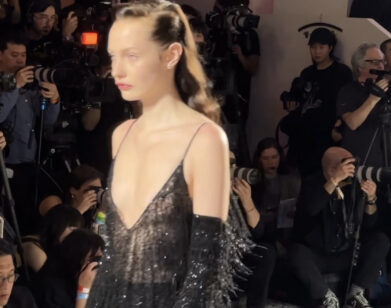
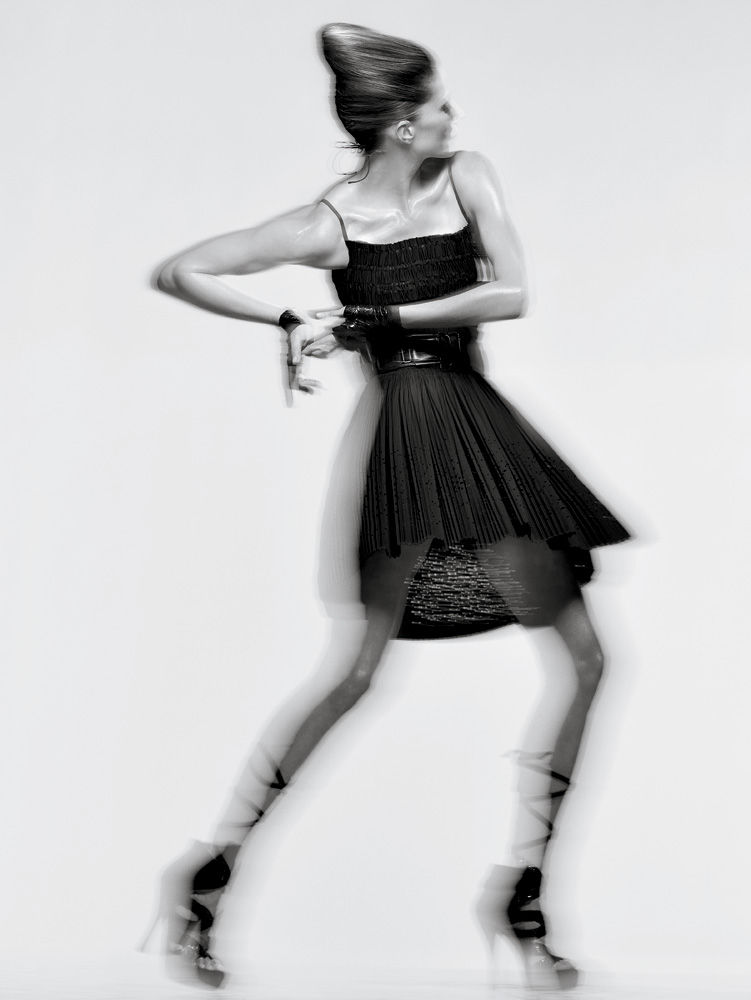
Azzedine might be the designer who best understands a woman’s anatomy, which makes sense because he also is a man who understands a woman’s heart and soul. The poetry of Azzedine comes from the fact that he is always free. Buying back his name from the Prada Group in 2007, he formed a partnership with the Compagnie Financière Richemont which allows him to design his way-usually very late at night with an old film playing in the background. Azzedine is not only a great couturier, he is a historian of couture and he is now setting up a foundation to preserve his archives and his priceless haute couture collection.
Azzedine Alaïa is a classicist, possessing a total understanding of the architecture of the female form, of how to drape, and of how to use materials. He doesn’t design for a season, he designs for a body. And he continually reinvents himself, always perfecting and improving on what he has done so brilliantly for a lifetime. I began collecting Alaïa when I started modeling for him as a teenager, and I own pieces that continue to astonish me every time I put them on. He even designed my wedding dress. I am honored that Azzedine entrusted me with this interview and that I can share with readers an intimate glimpse of a man who defines genius.

STEPHANIE SEYMOUR BRANT: Okay, Papa, I thought it would be good to start from the beginning. Tell me about growing up in Tunisia.
AZZEDINE ALAÏA: My grandfather in Tunisia was a police officer. He worked in the ID card department. When I didn’t have school, he would take me to work with him. I would sit next to the woman who made the ID cards, and she always took three pictures of people. This woman would use a cutter-the photo-booth paper was very thick-then she’d glue and stamp one picture onto the passport, give me another to staple onto their police files, and the third one would be thrown away. I would gather these scrapped photos from the garbage, put them in an envelope, and organize them later at home. I separated the blonde women, the brunettes, the black women, and the men, too, into long hair, short hair, mustaches . . .
SSB: No, you didn’t! [laughs]
AA: Yes. And during the week I’d take them out and sort through them. I had almost all of Tunis at home with me. I loved the Italian girls. When they came for their passport photos they had ringlets of hair and wore communion robes, so they were my favorite . . . Well, after the blondes. [laughs]
SSB: How old were you at the time?
AA: Ten years old. My grandfather also took me a lot to the cinema. One of his friends had a movie theater called Ciné-Soir. There were Egyptian films, Italian films . . . My grandfather would leave me in the theater, go to work, and come back at the end of the day. There was a café next to the theater, and he’d often play cards with his friends in the evenings while I watched all of the screenings.
SSB: So this is where you got your love of film. Who first influenced you to go into fashion?
AA: There was a woman in Tunisia called Madame Pinot. She was a midwife and had helped in the birth of my siblings and me. I assisted her. I helped women give birth to a lot of babies when I was very young. She’s the one who first taught me fashion. And she enrolled me in the École des Beaux-Arts. She was very close with my parents and grandfather, and I’d spend weekends with her. On Saturdays we’d wander around together, and on Sundays she’d dress me up and take me to church. She and my grandfather were really the two most
important people in my development.
SSB: You were studying art at École des Beaux-Arts, not fashion. Is that right?
AA: Yes, I was studying sculpture.
SSB: So did you move to Paris to become an artist?
AA: No, I simply loved French culture. I learned French in Tunis, along with Arabic. I also learned French history. I knew the entire history of the kings of France. And I was fascinated by Versailles.
SSB: Were you already making clothes by the time you moved to Paris?
AA: Yes. During vacations from school I worked for a small dressmaker who had posted an announcement looking for someone to do finishing work. I actually went to see her for
my sister so she could have a job sewing at home. In the end my sister and I both would work on the oversewing at night and
I would bring the dresses back the next day.
SSB: What happened next?
AA: There was a big Tunisian family who had a palace in the Arab section. These two young sisters were always on the balcony and they would see me go by. One day they asked, “What are you doing at that dressmaker’s?” I told them, “I am taking a job to buy charcoal and paper for school.” The two sisters said, “Oh, we know a dressmaker who is making Dior copies here in Tunis. We will introduce you to her.” I started learning from this woman. Then I met my best friend, Leila, whose mother had connections to clients of Christian Dior in Paris, and eventually someone asked if I could come work there. I got the job. But when I arrived, it was the end of the Algerian War. After five days there they said to me, “You can’t work here any longer. You’re a foreigner.”
SSB: So you only worked at Dior for five days?
AA: Yes, just five. It was always women who ended up helping me. Madame Simone Zehrfuss took care of me. She was the wife of the famous architect [Bernard Zehrfuss] and she took me to her home. That day, Louise de Vilmorin, who ended up being extremely important to my future, was there. She was a writer, a kind of Cocteau. She was [André] Malraux’s companion. She invited me to her home and there were suddenly so many interesting people.
SSB: De Vilmorin and Malraux were the crème de la crème of Paris. That’s wonderful company. Is that really where you started to encounter the Parisian scene?
AA: Along with the help of Simone Zehrfuss, who translated as well as introduced me. So little by little, women who I dressed started to come to me. There were the Rothschilds, then all of the big families of Paris . . . SSB: Where were you living at the time?
AA: I started living at the home of the Comtesse de Blégiers and I was working out of my room. I stayed there for five years. I was also doing a little babysitting there. Basically, I was babysitting and making clothes.
SSB: I love it!
AA: I washed the kids, fed them, walked them in the park . . . And I made the Comtesse’s dresses. At that time it was hard to even get a maid’s room if you came from North Africa. Being in France at the end of the Algerian War was very hard. But these women protected me. They wrote letters to the prefect for me, and the Comtesse’s husband gave me his card to say I was his protégé
so they didn’t bother me when they stopped me in the street.
SSB: After those five years, you went to work for Guy Laroche.
AA: Yes, for two years.
SSB: And after that, Thierry Mugler?
AA: No, Mugler was a friend and I helped him. But I never worked for him. It wasn’t a professional relationship. Guy Laroche was a tailoring atelier, so I went there to learn tailoring.
But eventually I wanted to go out on my own. I was happy in Paris. I wasn’t necessarily interested in becoming a “great designer.” But Simone Zehrfuss loaned me the money to get settled.
SSB: You famously settled in Rue de Bellechasse, which was extremely small. There were sewing machines everywhere . . . in the bathroom, in the kitchen. I have such fond memories.
AA: It made you laugh when you first visited! You were 14 years old.
SSB: Yes, I was. And I had never done a show in my life! I went on 20 go-sees around Paris and you were the only one who hired me. You even called your friends to try to persuade them to use me. Their response was, “Her rear is too round!” And your response was, “I think it’s perfect.” I was a total disaster in the shows. Your atelier was so small and you had to do three shows each day for seven days, so you just kept me on. That’s when we became so close. You really took care of me, Papa. [both laugh] Now tell us about Greta Garbo and what is was like to dress her.
AA: It was a dream come true. I was always, always influenced by her style. Still today, I create Garbo-inspired looks. I knew her through Cécile de Rothschild. That’s who she stayed with when she came to Paris. They were very close. And one day she came with Cécile to Rue de Bellechasse. I saw right away that it was Garbo. I said, “Mademoiselle Cécile, no need to introduce me.” Garbo was hiding a bit. She had her hair in a rubber band, with bangs and a very high turtleneck. She had very long sleeves because she wanted to hide her hands. But I noticed her eyes, the shape of her eyes and nose. She was sublime.
SSB: What did you make for her?
AA: Straight pants, flat shoes, jersey sweaters, and masculine-looking coats that were very simple and cut to her figure. One was an A-line-shaped wool evening coat with big velvet cuffs and collar, which hooked at the top. She had a nice shape but was not skinny. She was big but not fat at all. It was her face, though, that was most impressive.
SSB: And you also dressed Claudette Colbert?
AA: Oh, I became friends with everyone! Intellectuals, writers, artists . . . Even Jean Prouvé and Orson Welles. Louise was very good friends with Orson Welles. René Clair brought Claudette Colbert to me. She had high cheekbones and she walked fast . . . This was all in the ’70s, when I was at Bellechasse.
SSB: And you didn’t move to Parc Royal until 1984. You were really a secret for so long at Bellechasse. If a prospective buyer didn’t know somebody, there was no way they could get to you because your clothes weren’t anywhere else. It was like a secret club. Only the lucky few had Alaïa in their closets. But the world finally caught on when you started doing fashion shows. When did you receive the designer of the year award from the French Ministry of Culture?
AA: That was in 1985. They did the awards ceremony at l’Opéra de Paris. Grace Jones sang-I dressed her. Madonna was there with Yves Saint Laurent, and Catherine Deneuve, and Hubert de Givenchy with Audrey Hepburn . . .
SSB: Then the next year you did the Palladium show. My husband and I have talked so much about the importance of the Palladium to New York culture. Arata Isozaki did the interior architecture for Ian Schrager. Jean-Paul Goude did the scenography. The nightclub was filled with major works by Basquiat, Clemente, Scharf, and Haring . . . Then you have this show of Azzedine Alaïa’s. How did that show come about?
AA: It was after I did a show in Paris. Another sponsor wanted to host me but we had a fight about control. They wanted to choose the models. I also wanted to use Jean-Paul Goude and they didn’t know who he was. So I said forget it. And then Ian Schrager asked me for uniforms for the bartenders and waitresses at the Palladium. When I came to New York, I was introduced to him. He offered to give me the space to do the New York show. So we did it with Ian Schrager at the Palladium-my way. It was wonderful.SSB: Did you meet a lot of the artists when you were in New York at this time?
AA: Oh, yes. Basquiat, Haring, Clemente . . . At night we went to dinner at Mr. Chow’s. I was friends with Tina [Chow].
SSB: You’ve always kept a close relationship with artists.
AA: Yes, even before New York. Especially in Paris. Madame Zehrfuss held a dinner almost every week with only artists. I didn’t know anything at all, nothing, at the time. I remember the Zehrfusses took me to see my first Picasso exhibition . . .
SSB: And now you carry on her tradition of supporting artists, and bringing people of all sorts together with your lunches and dinners where you cook and serve. One can stop by your atelier anytime for lunch or dinner and always meet the most interesting people, not only from Paris but from all over the world.
AA: That comes from my grandmother. My grandmother
always set an extra place or two for someone coming, because her house was always open. I remember my grandfather would go get 20 baguettes every day, because everyone landed at my grandmother’s. She cooked all the time, and then at 70 or 80 she just left. She ran away.
SSB: What? She ran away?
AA: She was fed up at one point and she left. My grandmother disappeared to the south. She eventually came back, and my grandfather never asked her why she left. I think this kind of thing happens in a woman’s life . . . At least I see it in the women I know. At some point they assess who they are. My grandmother spent her whole life at home taking care of kids . . .
SSB: People often talk about how you work. You live by your own schedule. You make a collection when you’re ready to make a collection and show when you’re ready to show. It seems like you wait until you are completely and thoroughly inspired to do a collection. You are much more like an artist in that you don’t even think in seasons. Why is this?
AA: I don’t create a story. It’s in the materials.
SSB: I don’t know if people realize that your hand is in every dress. You pin everything yourself. I love the way you always have a fitting model living with you. You have a little room at your atelier where they stay and you knock whenever you need them-24 hours a day!
AA: Oh, yes, always. Naomi [Campbell] was one.
SSB: You often have movies playing while you work. What are some of your favorite movies?
AA: That’s hard. There are favorites for periods of time. I love film-it’s like painting. When I was a child, when I started to see foreign films, I was 10, 15, 17 years old. Really, there were Italian films, American films, Anna Magnani . . . but I can’t pick one. I can’t.
SSB: You love Magnani.
AA: I love Magnani.
SSB: So you like that whole film noir school.
AA: I like Marlon Brando. I like Marilyn Monroe. But it’s like asking what my favorite painting is. It’s very hard.
SSB: You’ve always been a great collector. In fact you have one of the greatest haute couture collections in the world. When did you start collecting other designers?
AA: I started in 1968 when Balenciaga closed his house. I was already at Bellechasse. The saleswoman who worked at Balenciaga started working for me. She took care of our clients, rich women from all over-some from America, a lot from Brazil. One day she brought me to Balenciaga after they had closed because I was going to buy the mannequins. The director of the house came in and gave me some packages. One day I see a woman cutting a Balenciaga dress to copy something that we were doing. It made me sick to see that dress cut and destroyed. It was one of the dresses from the 1955 runway show. There were the tags with the names of the models. All of a sudden I had this shock about haute couture. I said, “It’s sad that the house closes, this man dies, and everything disappears.” So I began to collect. SSB: Who are the designers from the past-maybe the ones you collect-that inspire you?
AA: All the big ones who have left their mark and who play a big role in the history of fashion. Vionnet is important. Paul Poiret, very important. If you want to even start with Marie-Antoinette . . . things from the 18th or 19th centuries . . .
SSB: But in the 20th century?
AA: The 1950s. That was a good fashion period. And at the end there was Dior, there was Schiaparelli. I knew Schiaparelli. She had a house in Tunis. And I loved Balenciaga. His work goes well with Spanish painting, with Goya.
SSB: Which designer influenced you the most?
AA: Vionnet. But when I started, it was Dior and Balenciaga.
SSB: I know you can’t name your favorite film, but what about favorite films for fashion?
AA: There have been things that have inspired me a lot. The chain mail in The Devil’s Envoys [1942]. The zip-up dress in Hôtel du Nord [1938]. It’s really because the actress Arletty [Arlette-Léonie Bathiat], who was in both of those films, had a particular spirit. She was very intelligent.
SSB: Which costume designer did you admire the most?
AA: Adrian was fantastic. I have a lot of Adrian in my collection. The film I like most that Adrian did was The Great Ziegfeld [1936]. The way he dressed those women!
SSB: Now let’s talk a little bit about the foundation you’re starting. It’s based on your archives, but you’ll also have exhibitions?
AA: Yes, and not only on fashion, but on photography, design, painting . . . First I have to archive everything. I will also have every single one of my own collections-in several variations. Your name is there in some of the dresses.
SSB: Oh, yes?
AA: I almost always put in every dress the name of the model who wore it . . . And the foundation will also help young people. Because they don’t learn tailoring in school anymore, only drawing.
SSB: That’s a shame.
AA: I didn’t learn to sew at all! I didn’t go to any school. But when I see things, I’m curious to know how they evolved. So young people will be able to see from the work there.
SSB: I remember when I was modeling for you, all of the girls fought over your clothes. We didn’t want to be paid a fee. We wanted the dresses, the jackets . . . We left with a lot of your clothes in big bags! I thought I would take one dress but I’d end up leaving with 20.
AA: I gave you clothes because you gave me your time . . . The models didn’t ask at first. I was the one to give the clothes to them.
SSB: Everybody was fighting for the clothes. Linda, Christy, Naomi, Tatiana . . .
AA: Yasmin . . .
SSB: It was a frenzy. One of your early assistants, Eric, was the only one who could find the right size for you. They were all in little boxes. You had to wait your turn and you had to pray that they didn’t run out of sizes, because all the girls wore the same sizes. It was fantastic! And everybody would say: “You haven’t gone yet? There’s not going to be anything left!” [Alaïa laughs] And your work now is better than ever. It has become more and more beautiful, more perfectionist. You’re never satisfied.
AA: I’m happier about my friends than I am about my work. I still have a long way to go with work. My friends, that’s the one thing I’m sure about.
SSB: Don’t forget about your daughters, Papa-all of us girls who you took so much care of. And your grandchildren.