


Mike Tyson


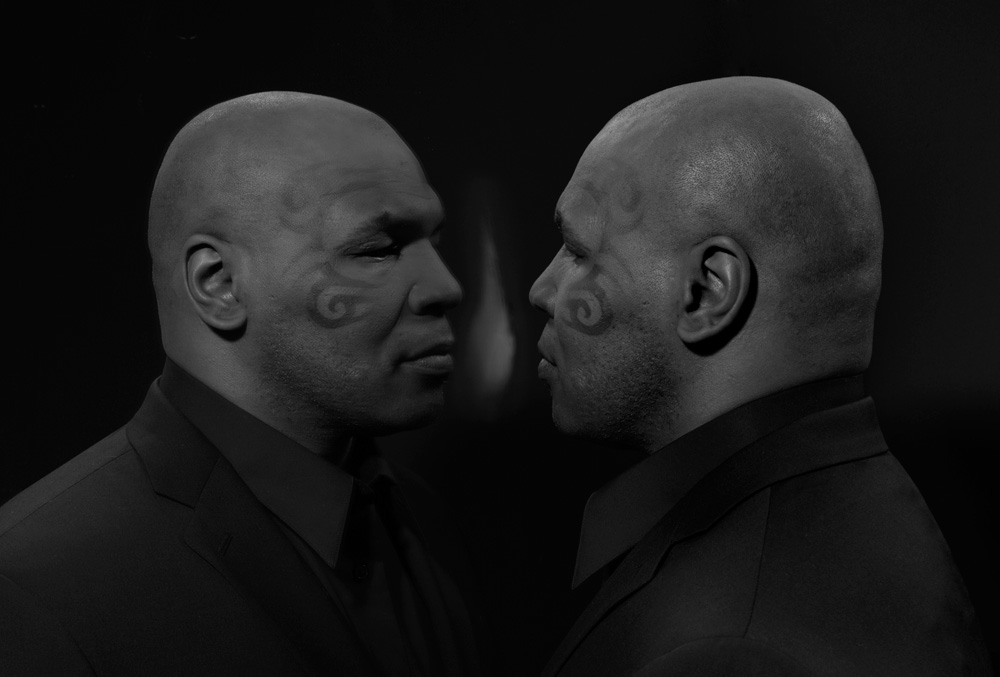
The world is a small place, and it’s getting smaller all the time. Two weeks before I was asked to interview Mike Tyson, I went out onto the balcony of my Los Angeles hotel room and saw him sitting on the terrace right next to mine. He puffed a cigarillo and impassively watched the plumes of smoke dissipate into the air. After thinking better of it, I said hello (something I would rarely do on such an occasion), and he turned slowly toward me—at a rate of speed so reduced I wasn’t even sure he was moving. Then, at an equally leisurely pace, he raised his right arm, flashed a thumbs-up and returned to the task of keeping the cigarillo burning. So, after heading out to meet him on a pitilessly hot Burbank afternoon, I am shocked that he remembers me. “I know you,” Tyson says, as he offers an enormously genial handshake. There’s something entirely unhurried about him now, as if he’s taking the world in on its own terms instead of trying to get in the first lick. In James Toback’s documentary Tyson, the former champ reveals closely held confidences and secrets rather than unleashing them. Even the knockout blow he tosses in his lovably funny cameo in The Hangover comes with a leisurely—yet still brutal—lack of rush. And he takes his time immersing himself in this interview. But once he’s ready, Tyson, now 43, is waist deep in talking, and excitedly, happily, pulling together connections and moving from one topic to another.
ELVIS MITCHELL: One of the things that amazed me about the Jim Toback documentary is the part when you talk about having asthma. I mean, you basically went into the ring every time with the idea of trying to win the fight quickly because you were afraid that you wouldn’t be able to breathe. It’s interesting, too, how you were talking about having these memories of being in the hospital as a kid. What’s your first memory of that?
MIKE TYSON: Asthma? Couldn’t breathe one day. I was real young. I don’t know how old I was—probably about three.
MITCHELL: And you had an attack and needed to go to the hospital or something?
TYSON: Yeah.
MITCHELL: It was interesting to see in the documentary how you were actually kind of a shy, sensitive kid.
TYSON: Yeah, this is true. But that quickly changed when my parents moved into this neighborhood called Brownsville, Brooklyn, which was just totally different than the neighborhood we lived in before. The people in Brownsville were very aggressive. It was like a dog-eat-dog world. So I had to get familiar with it.
MITCHELL: You’ve talked about how other kids were robbing people and stuff.
TYSON: Yeah. I was just a little kid, and I watched these guys . . . They would come back around the neighborhood later, and -people would be slappin’ them five and talking about what they did. Or the older criminals would say what they should have done. It was like they’d come back and have a press conference. [laughs] I was like, Wow. This is exciting!
MITCHELL: Do you feel like you ever really got over your -shyness at all?
TYSON: I don’t know. Maybe a little.
MITCHELL: Because you still seem like you’re kind of reticent about talking in a lot of ways.
TYSON: I don’t know. I don’t feel much like talking about my past. I can’t believe I was expressing it on tape like I did.
MITCHELL: But when you were fighting, you talked about yourself more, and in different kinds of ways, than any other boxer I can remember.
TYSON: Muhammad Ali was pretty open with the public.
MITCHELL: But still, it was like there were two different Alis. There was the Ali who was the showman, and then there was the guy he was with his squad, with the Black Muslims. But you kind of opened up every aspect of your life to people.
TYSON: I don’t know. It’s just who I am.
MITCHELL: I was talking to Jim about your reaction at Cannes after Tyson screened there last year and the film got a 10-minute standing ovation. He said that he felt like you were of two minds about it. Do you remember what you were thinking at the time?
TYSON: Yeah. I was thinking, What the hell am I doing here? It was just something new to me. I’d never dealt with movies from that perspective—being a participant, so to speak.
MITCHELL: But Jim told me that you were also saying that you were suspicious of all the white people accepting you.
TYSON: I was just saying that those were my thoughts that I was having at the time . . . I would look to sabotage something because it was going so good. When things go so good like that, normally my old self would sabotage it.
My objective was to hurt the other fighters. i wanted to hurt them. . . man, I was a wild thing. It’s kind of a drug, a rush.Mike Tyson
MITCHELL: Do you feel like you’ve gotten past that old self mostly, or do you still feel bits of it?
TYSON: I work on it consistently. I guess I have more faith and confidence in myself now.
MITCHELL: There’s a point in Tyson when you talk about your frame of mind before a fight. When you were in the dressing room getting ready to go out, you’d be afraid. But the closer you got to the ring, the more confident you got.
TYSON: Well, because being in the ring became my reality, and, in my reality, I’d think I was someone special.
MITCHELL: But you were something special.
TYSON: But that’s the frame of mind I had back then. When I was young, I thought I was a god. Now, I just basically work on staying humble. My priorities changed. Just to be able to try to change them—that was frightening to me.
MITCHELL: It seems, though, like fear has been something that’s motivated you.
TYSON: Fear and the thought of failure . . . But we don’t really know what fear is. Fear is something that we create in our own minds. Fear could be like fire. You can use it to heat you up, keep you warm, cook your food. There are so many things you can use it for. But if you allow it to go out of control, it will destroy you and everything around you.
MITCHELL: So you’re talking about this combination of fear and discipline.
TYSON: Exactly. Discipline is doing what you hate to do but doing it like you love it. But with fear, it’s not so much about learning how to use it but how to embrace it.
MITCHELL: Did [Tyson’s first trainer] Cus D’Amato help you recognize how to deal with that?
TYSON: Oh, 100 percent. I never knew anything about that stuff until Cus brought it to my attention—that it was healthy to feel fear. If you didn’t feel it, then you were either crazy or you were a liar. Because it’s unnatural to fight somebody who has nothing against you and never did anything to you or to your family, who never stole anything from you. And now you’ve got to go and try to dismantle this guy . . . It takes -discipline to do that.
MITCHELL: What was always so much fun about watching you fight is that you would propel yourself off the balls of your feet to hit somebody. We’re used to seeing heavyweights kind of move in and twist their body into the punch. But you would throw yourself into it, almost like it was a street fight.
TYSON: Well, I was blessed with speed and a good punch. Everybody thinks I’m the hardest puncher ever. But I just think I was really fast, and my punches got to the target faster. That’s what made my knockouts always seem spectacular.
MITCHELL: You don’t think you were one of the hardest punchers?
TYSON: I do think I was a very hard puncher, but I was also a very accurate puncher if I hit you on certain spots and stuff . . . Guys like George Foreman could hit you in the back or on the side of the head or behind the ears and knock you out. But most of the heavyweight guys were so much bigger than me.
MITCHELL: So your strategy was to get up in your opponents’ faces and try to get to them as quickly as possible?
TYSON: Yes. You have to be consistent if you want to break their spirit, their will. Because that’s really what fighting is about . . . People see it as a physical contact sport, but it’s not. It’s really a spiritual one of will against will. Who wants it the most? How much is he willing to take—and dish out—to get it? It’s like fighting is 10 percent physical and 90 percent emotional.
MITCHELL: I remember you saying that you had mastered the art of skulduggery.
TYSON: Yeah. I was an emotional manipulator of fighters . . . You have to know how to be cold, you know? Just have no -emotions, no feelings. It takes time, though, to develop that. I’d been working on that since I was 12 years old. It doesn’t happen overnight. My objective was to hurt the other fighters. I wanted to hurt them. I wanted to be merciless. Man, I was a wild thing. . . It’s kind of a drug, a rush. But that’s just how I was as a kid . . . It’s funny, because Cus was always saying that Ali was better than anybody because he controlled his emotions and his fears. Ali was just an emotional juggernaut.
I didn’t see myself going anywhere in a bright light. I was getting dark. I didn’t like the guy I was becoming. Mike Tyson
MITCHELL: And, like you, a great manipulator of other people’s emotions.
TYSON: Yeah.
MITCHELL: Is that one of the things you got from him?
TYSON: Well, I used to read a lot of books. Cus used to tell me about people like the Borgia family. He used to talk about their character and what they were about, manipulating . . . Cus knew all that stuff. He just had so much confidence in me. He said, “All right. We’re going to take this method of life, and we’ll be able to accomplish anything. There’s nothing worthy of being intimidated by for us.” I’d never had that kind of ideology before. I didn’t come from a household where my mother dragged me outside and said, “You’d better fight.” My mother wouldn’t let me fight. I was not an aggressive kid.
MITCHELL: What did it feel like to you the first time you were out of the country and people were recognizing you?
TYSON: It was crazy. In 1986, I went to London, and they had this big dinner for me, like a banquet. I was just 19, 20 years old, and I was like, “Whoa!” Everybody knew me. I was at the Grosvenor House, and they closed the gate because too many people were there. It was just crazy—like I was the Beatles or something.
MITCHELL: Is that when you first started to get addicted to it a little bit?
TYSON: Yeah, exactly. It made me want to win fights like the fighters of old. I wanted that status. I used to read about all these legendary fighters in the boxing encyclopedia, and I’d always
be jealous. It was just amazing what they could do and how they would do it—the courage they would have to go about doing it.
MITCHELL: When was the first time you noticed that your relationship to fighting was different, that your emotional balance was changing?
TYSON: When I was 15 and I started taking it real serious.
MITCHELL: Is that when you thought you might have a future as a boxer?
TYSON: No, that’s when I knew I was going to be champion of the world.
MITCHELL: You knew that at 15?
TYSON: Yeah. Because, you see, I’d been planning on it since I was 12. I was very dedicated and serious about fighting. I’d read about all the fighters. I found out where they came from, knew about their mothers and their fathers . . . I just read all about their lives, their training.
MITCHELL: Who was the first boxer you studied? Was it Ali?
TYSON: Nah, no way. I knew of Ali. But I’m talking about studying them. I probably looked at Henry Armstrong first.
MITCHELL: Oh, so you went that far back.
TYSON: Yeah . . . I actually went all the way back to 1812.
MITCHELL: To when it was basically bare–knuckle boxing.
TYSON: The Kings’ Rules, yeah. And then I started looking at guys like Jack Dempsey because they were mean and tough. In today’s society, you want fighters to be white knights in fucking armor who come and save the day. But back then they were just hard, mean men. Jack Dempsey was also the first million-dollar fighter. This was in the ’20s, when you could buy a steak dinner for 25 cents. He’d had a hard life, and he fought hard. America had seen nothing like him before.
MITCHELL: Sonny Liston was one of those guys too, who had nothing else going for him but fighting.
TYSON: Exactly. There was this guy named Joe Gans who fought in the 1890s and the early 1900s. He fought in the Jack Johnson era, and he was like the patriarch of black fighters. And then Johnson came along and became bigger than the sport. Johnson was just amazing. He had like a third-grade education but spoke something like seven different languages. He was also very cynical.
MITCHELL: But he had to be. Did you find that you became cynical at a certain point too?
TYSON: You do become cynical. There’s a lot of Jack Johnson in all of us. But he was a bad man all his life. The guy was denied for so long . . . He lived in 1908 like we live today. Today, we live and speak our minds and never hold our tongues back to white people. But in Jack Johnson’s day, you could get killed just for looking at a white woman, and Jack Johnson married three of them.
MITCHELL: Johnson has always struck me as being really the first black athlete who was like Ali—who was the same person with white people as he was with black people.
TYSON: Society wasn’t ready for him. Black and white—people just weren’t ready for him.
MITCHELL: But that seems to be the case with a lot of boxers. Look at Ali. And then, in a lot of ways, society doesn’t know what to make of you either.
TYSON: That’s absolutely right. But they didn’t have no NAACP in Jack Johnson’s day—it was established in 1909, and by that time, Johnson was already champion. He just wouldn’t take no shit. Guys like Joe Gans and Sam Langford were great fighters, and society wasn’t too keen on brutalizing them because they were kind of Tom-ish. They were nice and, you know, submissive. But Johnson was an extrovert. There’s this story about how he was driving through a town and he was speeding, and the police stopped him and wanted to charge him $25 for a speeding ticket. This is 1908, right? And he probably was speeding. So Johnson gave the officer a $50 and said, “Motherfucker, you hold on to that because I’m driving back the same way.” [both laugh]
MITCHELL: People forget how important Jack Johnson was, because 30 years later, when Joe Louis became champion, he was once again playing the nice guy.
TYSON: Because of Jack Johnson, they didn’t let a black man fight for the title for a long time. In 1910, when he beat Jim -Jeffries in Reno, there were race riots afterward. Oh, man, so many black people died that night. But Jack Johnson had been all over the world. He’d been everywhere. No black man at that time traveled like he did.
MITCHELL: And look at you now—I mean, they threw a parade for you when you went to Moscow.
TYSON: Yeah, it’s interesting. I was just talking to somebody in a clothing store. I went to buy this outfit, and the guy said, “You’ve been to Chechnya before. I saw you in Chechnya.” Everybody’s strapped in Chechnya; they all walk around with M16s. But I’m Muslim, and they’re Muslim, so they love me.
MITCHELL: You’re like a king over there. You hear these stories about the Russian mob . . .
TYSON: Oh, I met those people. I won’t say “Russian mob,” okay? I won’t use that word.
MITCHELL: I’m sorry. Forgive me.
TYSON: But these guys were . . . These were interesting guys. They ran the city. They had a dinner for me in Moscow, andit takes two hours to get to your meal because everybody’s toasting. All they do is toast. I said, “When will they eat this fuckin’ food?” And somebody would say, “I’d like to make a toast . . . ” These guys are extremely intelligent, but it’s a totally different life.
MITCHELL: I was wondering what you thought of heavyweight boxing today. What do you think has happened?
TYSON: Well, there are no stars. If you had a star electrifying the heavyweight division, then boxing would light up again.
MITCHELL: You have stars in the lesser weight classes.
TYSON: Yeah, but people want to see a heavyweight beating people to death, knocking them out cold.
MITCHELL: Is there anybody who you think could potentially be that guy in the next couple of years?
TYSON: I haven’t seen anybody yet, but I’m sure there’s somebody on the horizon.
MITCHELL: I find myself watching the middleweights now more than anything else. When you were getting started, right after the Ali–Foreman period, the middleweights were dominating. You had Sugar Ray Leonard, Tommy Hearns,
Marvin Hagler—all these guys who were small and fast. I always thought you fought like one of those middleweights because of your speed.
TYSON: I always admired guys like [Jimmy] Robertson, -[Carlos] Monzon, [Roberto] Duran. They were phenomenal fighters. A lot of people say I’m better than those fighters because I have more notoriety. But I have the utmost respect for them. Goddamn, could those guys fight. Wilfred Benitez? Shit! Alexis Argüello? Fuck, man, did he hit guys. When Tommy Hearns knocked out Pipino Cuevas, Hearns knocked him dead. I thought no one in the welterweight division hit harder than Hearns. He was a freak.
MITCHELL: Because he was so fast and so skinny.
TYSON: And tough as shit, too! You ain’t gonna beat him on no decision. You got to kill this man to
beat this man! Now, look at how people handle their fear differently: Going into a fight, most people would be thinking about how they’re going to strategically do this or do that. But Hearns says, “Fuck it. We’re gonna shoot it out, motherfucker!” All of a sudden, a guy who is afraid becomes a killer. He’s scared to death, but he’s trying to kill this guy! It’s just an oxymoron, that side of fighting. These guys are frightened to death like cowards, but they’re fucking assassins. It’s strange—the psychological warfare in fighting.
MITCHELL: To me, that period, from around 1975 until you came along in 1985, was the most exciting period in boxing. There were people coming from every weight class.
TYSON: I was a little kid coming up watching those guys. Fighting was off the hook back then.
MITCHELL: But it’s almost as though you studied all of these other boxers we’ve talked about, and then said, “This is who I need to be to make this exciting. I need to be like this. I need to bring in this . . . ” It’s like you brought something from every era of boxing into the ring when you fought.
TYSON: Exactly.
MITCHELL: Did you ever get over being afraid?
TYSON: I felt the same fear in my first fight as I did in my last fight. It never goes away.
MITCHELL: When did you get the call from Todd Phillips about doing The Hangover?
TYSON: I don’t remember. They called me about it, and I said, “Okay, let’s try it out.”
MITCHELL: You’ve turned up in some odd movies. You’re in Crocodile Dundee in Los Angeles [2001].
TYSON: Yeah. I can’t remember how that one happened. I was just walking on by, I guess, and they picked me up.
MITCHELL: Well, it’s unexpected. You think you know what a Crocodile Dundee movie is going to be, and then there’s Mike Tyson in there.
TYSON: I’m looking forward to doing more in the acting field. I want to try it out.
MITCHELL: Do you want to play characters other than yourself?
TYSON: Yeah. I don’t want to be Mike Tyson all the time. I just want to see what I can do. I’m fortunate that people have embraced me in the movies. I’m looking to see how this thing all pans out.
MITCHELL: What did you think of The Hangover?
TYSON: I just thought it was a funny movie.
MITCHELL: What did you think when you saw yourself?
TYSON: Not really that much because it wasn’t such a long scene, but I thought I was cool.
MITCHELL: A lot of people don’t know this, but you’ve been in Las Vegas for most of your adult life. Why do you live there? What do you like about it?
TYSON: I’ve been living in Vegas since 1984. I’ve just been there so long I don’t even know why I’m there anymore. “Why am I here?” I say to myself. I’m just used to being there . . . But we’re getting ready to get a house in New York or somewhere else, Fort Lee [New Jersey] maybe. I think that’s the plan. I need to go back to New York for a little while. I really miss it. I need to go back there and hang out, see my old friends, see those old faces.
MITCHELL: Tell me about your relationship with Michael Steele, the chairman of the Republican National Committee? [Tyson was briefly married to Steele’s half-sister.]
TYSON: Michael Steele is like family. My kids and his kids are first cousins. I like Mike a lot.
MITCHELL: Do you talk to him much about politics?
TYSON: No. We don’t talk about politics. He’s a good guy, Mike. You look at guys like Machiavelli? He was a nice guy. But his politics were lethal . . . [laughs]
MITCHELL: So you can’t really talk politics with Michael Steele, can you?
TYSON: No. I don’t want to. I’m not a Republican, but I have some conservative views on certain things. I’m not a Democrat, either. It’s just very difficult that these people hate each other over a belief. I think it all comes down to ego and competitiveness.
MITCHELL: You think so?
TYSON: Yeah. They all want to get the credit for saving the country.
MITCHELL: It’s interesting now that both the president and the head of the Republican National Committee are black.
TYSON: It’s pretty cool. But you’ve got to continue to fight. Being African-American in this country, we should always remember . . . People our age, who were born in the ’60s, were born into turmoil, and just see how far we’ve come . . . We were property at one time. I mean, what the hell do you think these people endured in order for us to live the life that we have now?
MITCHELL: It just feels like things are changing in a lot of ways, and yet a lot of things still haven’t changed. There are still a lot of racial attitudes that exist in this country that I think we’ve forgotten because there’s a black president. There is, of course, the story about Henry Louis Gates Jr. and the run-in he had with the Cambridge police . . .
TYSON: Yeah. See, in my personal opinion, I don’t think that’s something that Obama should have been involved with. [Gates] should be just like anybody else. You state your complaint, you get your supporters, and your guys march on a certain police station. I believe in that kind of stuff.
MITCHELL: Were you surprised that Obama publicly weighed in on that situation?
TYSON: I don’t know. He knows what he does. I understand. We’re all different people. Some things we just have to handle diplomatically.
MITCHELL: Is it easier for you to do that now than it used to be?
TYSON: Oh, 100 percent.
MITCHELL: Because of the state of boxing right now, you must have somebody come up to you at least once a year who wants you to get back in the ring and says, “Name the amount.”
TYSON: Yeah. I’m not interested in doing that, though. I get a lot of offers, but I’m not interested in doing that.
MITCHELL: What made you decide to walk away from boxing?
TYSON: I don’t know. I didn’t see myself going anywhere in a bright light. I was getting dark. I didn’t like the guy I was becoming . . . Boxing is an ego-driven sport. The idea is to not get too personal or emotional with it. You just know when it’s over, it’s over, and that’s it.
MITCHELL: Was it hard for you to walk away?
TYSON: It was the best thing in my life. Because I was just becoming some kind of . . . I didn’t expect that I would become what I was fighting. I became very aggressive, very confrontational. I felt like I was always onstage.
MITCHELL: Did you like being onstage?
TYSON: Yeah, it was addicting for a moment in
my life.
MITCHELL: But sometimes addicts have a tough time not falling back into their addictions. Do you ever feel sometimes that you miss that rush of fighting enough to want to try to recapture it?
TYSON: Never. I have no idea what I’m going to do, to tell you the truth. I’m just embarking on this new life that I have an opportunity to live. Everything seems to be going well, so I’m just trying to stay on track. I just want do the best at whatever I can at this stage in my life. I’m just enjoying this—being happy. I haven’t been happy in a long time. And living with responsibilities, being responsible for my actions.
MITCHELL: You had a pretty awful tragedy recently, too. [Tyson’s four-year-old daughter, Exodus, died in May.]
TYSON: Yeah . . . [pauses] I don’t even know what to say about that . . . But things happen . . . Adversity either makes the strong stronger or the weak weaker. To be weak in this world is just disastrous.
MITCHELL: What do you want to do next?
TYSON: I’m just moving forward. My life basically is just sitting down with my wife and making plans for certain things, planning out our day, planning out our life. It’s just little things that we have to do, the small things. I take everything as it comes.
MITCHELL: Do you miss the excitement and the craziness of the old days?
TYSON: Periodically, but then I know the headache that comes with it, and I don’t want to deal with that. I don’t want to deal with the hangover.
Elvis Mitchell is Interview’s special correspondent.
Photo credits: Fragrance: CK FREE by Calvin Klein. Grooming: Ibn Jasper. Production: Kyd Kisvarday/NORTH6. Stylist assistants: Karen Kaiser and Elin Svahn.