


Keep the fresh content coming by signing up for Interview newsletters.
Becoming an Interview registered user allows you to save content into Your Library and share with others.
Thank You.
You are now registered with InterviewMagazine.com
Click to Close
YOUR LIBRARY IS EMPTY
Start your library by clicking the
ADD TO MY LIBRARY button found
throughout the following forms of content:
My Library URL
Culture
Mayor of the Mundane: Harvey Pekar
10/13/2009 06:49 PM
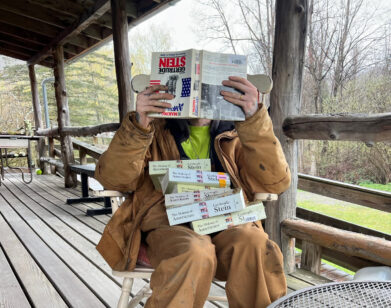
Located in Cleveland, Mac's Back Books is a frequent pit stop for local legend Harvey Pekar. Since 1976, Harvey Pekar's autobiographical American Splendor comic books have been published "off the streets of Cleveland". A VA hospital file clerk by day–and occasional David Letterman foil by night–Pekar broke boundaries by writing about his humdrum life in format something less than comic. His doom-and-gloom career reached a new level with release of the 2003 film American Splendor, in which Harvey was played by Paul Giamatti. Post-film, the now-retired Pekar has devoted his time exclusively to writing graphic novels–including 2006's Ego & Hubris, about our interviewer–and working on the Pekar Project, an ongoing webcomics series produced by Smith Magazine. When I visited Mac's Back, I found that they had a copy of everything Harvey had ever written–except for Ego & Hubris. In typical American Splendor fashion, every silver lining had a dark cloud. (ART CREDIT: THE PEKAR PROJECT)
On the eve of his 70th birthday, I sat down with the mayor of the mundane to discuss "magic land" Cleveland, his favorite late-night comic, his career, and the one story about his life that he will never write.
MICHAEL MALICE: I had a sense of dread coming here because of Cleveland's reputation. But I've enjoyed the sense of history; it's almost like a time capsule because when industry goes away things stop the way they were.
HARVEY PEKAR: If you just stayed here in Coventry all the time, you'd in all probability be pretty goddamn happy. That's sort of how I live my life: I live in a great neighborhood in a lousy town.
MALICE: Are you familiar with John Waters, the director?
PEKAR: Yeah, I'm familiar with him. My wife Joyce Brabner actually worked with him.
MALICE: In what way?
PEKAR: He's from Baltimore and she's from Wilmington, Delaware. They're real close. There's an art scene down there that takes both of them. When he was starting out, she helped out on some of his films.
MALICE: That's not a surprise, because the feeling I got walking around here is that it reminds me of his Baltimore. You've got pockets of quirkiness surrounded by a town which has a bad reputation.
PEKAR: Cleveland has a very bad reputation, but there's a lot of stuff that's left over from when there were very wealthy people–the Art Museum and a world class symphony that's still world class. At one time, there was this mayor named Tom Johnson who was a disciple of Henry George; he was into urban socialism. He took over the municipal light plant and tried to take over the transit system. There were a lot of jobs and so a lot of stuff got built. Then, in the '50s, things started to fade.
MALICE: A lot of people like to make a joke, but I don't think it's that funny to watch a town fade away.
PEKAR: No, it's sad. We had this mayor Ralph Perk who was kind of a fuckup. He was supposed to be doing this ribbon-cutting ceremony, but they were using a blowtorch to cut the ribbon. Instead he set his hair on fire.
MALICE: Why was he using a blowtorch?
PEKAR: It's Cleveland. It's a magic land.
MALICE: Do you see any similarities between yourself and Andy Warhol? He was someone else who took comic books, which were supposedly an ephemeral thing for kids, and he kind of elevated it. I don't think you elevated to this fancy place like he did, but you certainly took it up a few notches.
PEKAR: I always wanted praise and I always wanted attention; I won't lie to you. I was a jazz critic and that wasn't good enough for me. I wanted people to write about me, not me about them. So I thought, What could I do? I can't sing, I can't dance, I can't act or anything like that. OK, I can write. I thought about comics. I had met [fellow underground comic artist] Robert Crumb when he lived in Cleveland, and I saw some of the stuff he was doing. It dawned on me that comics were not an intrinsically limited medium. There was a tremendous amount of things you could do in comics that you couldn't do in other artforms–but no one was doing it. I figured if I'd make a try at it, I'd at least be a footnote in history.
MALICE: You'd be the first at something.
PEKAR: That's right. So I figured that would be my direction. I mulled and thought about it for a long time. When Crumb was at my house in 1972–he used to crash at my place–I wrote a bunch of stories. I said, "Just tell me the truth. Do you think these are viable or not?" because he's an honest guy. So he said, "Yeah. Can I take some of these home with me?" That gave me a tremendous break and it really gave me a head start because everyone had heard of Crumb. So if they hadn't heard of this guy Pekar, it couldn't be all that bad.
MALICE: I read some of the early comics and you don't refer to yourself as Harvey. Why is that?
PEKAR: That's just stupidity. I had been reading a lot of autobiographical stuff, these guys who are obviously writing their own autobiographies but they changed the name. So I picked it up. I just thought that was the way to do it.
MALICE: Who were these guys that you were reading?
PEKAR: The guy that had the biggest impact on me, although he was a big bullshitter, was Henry Miller. When I was about 20, I used to hang around with these guys and we all considered ourselves intellectuals.
MALICE: Obviously you've got a bit of a pessimist's worldview, although I don't think it's as bad as everyone says. Letterman didn't put you over and make you a household name. You were kind of a clown for him, a dancing monkey in his eyes. What gave you the stamina to keep plugging away with so little reward?
PEKAR: First of all, I got good reviews. Once in a while there'd be something in the Village Voice, and that would perk me up. Guys that I knew would see that stuff, so it kept me going. It's a small world, I guess. People I knew liked my work, and that made me happy. The fact that I was doing something new, there was no doubt of that in my mind. So I thought it was just a matter of time. Maybe I'd be dead-I wouldn't like that. I had some pretty down moments, especially in the 90s. I was with Dark Horse comics. At least when I self-published I designed it for myself, it was 60 pages and 8.5" by 11". All of a sudden I'm getting less than half; they were putting out like 28-page comics. I couldn't get as much in as I wanted and I was bummed out. I used to like to write long stories that were pretty complicated, and the length precluded that. They didn't treat me with that much respect, because my stuff didn't sell. That's the way it is.
MALICE: But there's something to be said for having a boutique artist who gives them cred.
PEKAR: Actually that's true, and that's why they kept me. My page rate kept doing down, too. Eventually it was like, What have I gotten myself into? I've got to get out of this thing! So then along comes my second huge break, which was the movie. Random House wanted to put out some collections of my work and, lo and behold, they sold. I thought nothing could make them sell. If I was on Letterman and getting over pretty well, and people were getting a kick out of me, and that was millions of people–
MALICE: –And a movie audience is tens of thousands, and that's just a fraction
PEKAR: I just thought, no way can this work. And when Ted Hope optioned the movie, I thought, Well, that's another $1,500 he's wasted. But I was happy to get it. I still don't know how he sold the thing. It was pretty popular and won awards.
MALICE: This is a Barbara Walters question and I apologize in advance. But when you were my age, 33, what did 70 mean to you?
PEKAR: I never thought of it. I never thought of the plight of old people or anything like that.
MALICE: You never thought, When I'm 70, this is what I want my life to be like?
PEKAR: When I was 32 I was just starting in comics. I was thinking that I had my future taken care of because of my pension. What I didn't realize–it was really stupid of me but I wouldn't have done anything about it anyway-my pension depends on how much money you make. I always was at the bottom; I never wanted a promotion. I was offered them but I never took them. I was thinking that I was pretty sure I had a secure future, between social security and my pension. It turned out both of them combined could not support. So now I've got to write graphic novels.
MALICE: With the rise of the internet, talk radio and mass media and all the stuff like that, there's much more fringe views represented on all sides of the spectrum. You've been around politics since you helped your mom campaign for Henry Wallace in 1948. Do you think, 60 years later, politics has gotten dumber or smarter?
PEKAR: I don't know. I think it's always been bad. People will believe absurd things–in the 19th century and now.
MALICE: You've often told me that you consider yourself a ham. When you meet people, do you play up the "Harvey character"?
PEKAR: Yeah, somewhat. Less and less as I get older. I used to be on all the time, but I've calmed down or something. I'm just trying to get by, now. I'm really concerned about the career thing. I've got some really good projects that are stuck in the pipelines. I even asked the Vertigo editor what he would want me to do. He said that I should write the history of Cleveland and my life in it. Of course, I'd already written about my life in Cleveland. It would be impossible for me to write about my life in Cleveland without touching on some stuff more than once.
MALICE: You've never discussed your first marriage much. Was that where she left you for grad school?
PEKAR: That was my second marriage. I don't think I ever talked to you or anybody about my first marriage. It was embarrassing. What she put me through, man!
MALICE: That's something you don't want out there?
PEKAR: It makes me look like such an asshole. I know what I did. I couldn't bring myself to write about it. It's not easy.
MALICE: What big mistakes do you think you made along the way?
PEKAR: I don't think I made any really big mistakes; it's just that I chose something difficult to do. Looking back, I suppose I should be grateful that I got as far as I got.
Tags:
Advertisement
Add a Comment
Please sign in to leave a comment.
Not registered yet? It’s quick and easy. Click
REGISTER at the top of the page to get started.
Email
Share