


Richard Phillips on Being a Man
By
November 4, 2009


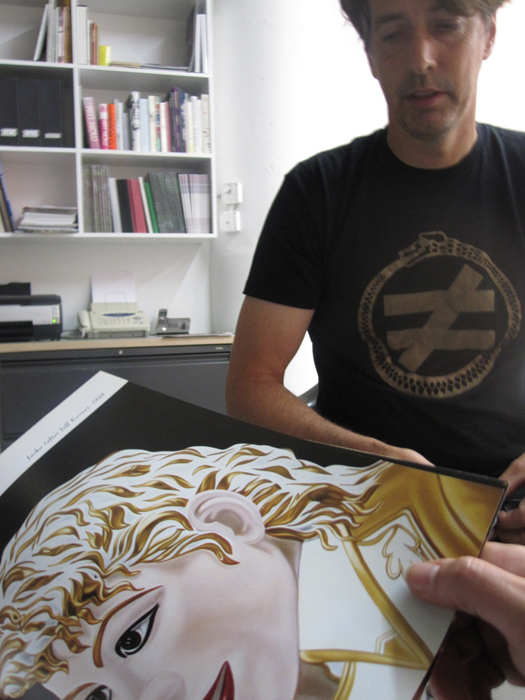
Richard Phillips is best known—and most criticized—for his realer than real portraits of high profile women, their sexuality pouring forth like so many handbags in a Louis Vuitton ad. In a new series, “Five Most Wanted Men,” he demonstrates how male celebrities make their own sales pitch. We go in for a studio visit.
Read the full interview at Art in America.
Photo by Noah Becker, editor of Whitehot Magazine.
Richard Phillips on Being a Man
When I first met Richard Phillips in the early 1990s, he was living and working in a tiny studio in New York City’s East Village that barely accommodated his six-foot-five frame. At the time, he was looking for a way out of the “upholstered” sculptures that introduced him to the art scene in the ’80s, as well as making satirical line drawings comparable to those of George Grosz. Today, at 46, Phillips is known for luscious oil paintings of male and female faces derived from photographs in fashion magazines. They have brought him notoriety, representation by Larry Gagosian, and product commissions from brands including Montblanc, MAC Cosmetics, and Jimmy Choo—the last of which recently licensed two Phillips paintings for now-coveted handbags. This past fall, Phillips even appeared as himself on an episode of Gossip Girl. He now lives in Tribeca with artist Josephine Meckseper and works in a spacious Chelsea studio with sweeping northern views of Manhattan. That is where we met to talk about “New Museum,” his exhibition of new paintings opening this month at Gagosian Gallery on Madison Avenue. The title work makes use of a 1970s photograph of two men on the Bowery slumping against a wall where the New Museum now stands—on a street that is no longer the last refuge of the lost. The other museum-size canvases in the show are based on a recruitment ad, pornography, and a tawdry “step-and-repeat” backdrop typical of red-carpet celeb photo ops. Each canvas provocatively repurposes its source and is as grotesque as it is sensual.
Linda Yablonsky: Wasn’t licensing two of your fashion-head paintings to Jimmy Choo selling out?
Richard Phillips: Not at all. Those images were initially appropriated from 1960s fashion magazines and were not considered art anyway, so when I had a chance to put them back into the fashion world, I saw it as a good artwork. I wasn’t putting a signature style on a bag, like Takashi
Murakami or Richard Prince, but getting out of the way that fashion operates, which is how my paintings operate. I try to get out of an image’s way in order to let it articulate what is hidden.
LY: In one of your “New Museum” paintings, we see every detail in the heroic, rugged face of a young man in uniform against an alpine landscape. What is he hiding?
RP: He came from a recruitment ad for the United States Marine Corps that I found in a surfing magazine. The male model posing as the Marine was inserted into magazines to encourage young men or boys to create a fantasy of valor that would draw them into considering the service—and, of course, fashion employs this kind of imagery in the same way. By putting the close-up of the Marine, which is a beauty image, in front of an icy 1930s Swiss landscape, it takes on a new psychological dimension where the representation of honor, strength, and valor becomes transparent, and the image’s construction out of artifice and fashion reappears.
LY: You have another painting with the same landscape in the background, but the face is of a beautiful young woman turned upside down.
RP: She’s from a pornography website called From Russia with Love. The backgrounds literally take away the original context and provide a beautiful, disassociated environment for the image to sit in.
LY: Is using pornography as source material a shortcut to making painting sexy?
RP: The answer to that is yes—on the one hand. On the other is the idea that sex is a part of our lives, but due to social constraints it has to be kept unseen as much as possible. Sex can be seen everywhere in advertising but the actual articulation of our sexual activity must not be seen anywhere but in pornography.
LY: But pornography isn’t there to represent sex. It’s there to incite it.
RP: There’s a book called Law, Sex and Christian Society [in Medieval Europe], which I used as the title of my last show in New York, that describes how the prohibitions of sexuality have dominated Christian life—and 70 or 80 percent of this country is Christian and subscribes to the notion that sex should be cordoned off. I don’t personally subscribe to that. In this “New Museum” show, each painting has either social or political consequence. In one, a woman is using a rolled-up copy of Frieze magazine as a sexual device. It’s a fantasy of a critical relationship between art and the body.
LY: When we first met, you were living in that apartment on 7th Street. You were just making the switch to the super-real fashion heads you’re known for now.
RP: What inspired me was a painting by Albert
Oehlen that I saw at a party I crashed at gallerist Daniel Newburg’s loft on White Street in 1992. It was a mirror painting from ’81 or ’82—a plant with an eagle on top—and it was such a startling painting that it literally ignited my interest. You could say my entire painting life is the result of crashing a party!
LY: Weren’t you in the painting program at Yale with John Currin and Lisa Yuskavage?
RP: I stopped painting about four weeks in and started making sculpture. I was inspired by having seen a work by Blinky Palermo where he had stretched drab green, monochrome cotton or linen fabric over the bars of a canvas stretcher and used it as a stand-in for painting. When I came to New York, I had the leather industry within easy reach, so I started doing my own work with it, but I put padding behind the stretcher to change its shape and make it into a sensual experience. Then I began to feel more like an upholsterer than an artist.
LY: What other artists were you looking at then?
RP: There were two shows that made a big difference, and both were by Jeff Koons. The first was “Luxury & Degradation,” which I saw at the end of the ’80s, where you had social and class strata being seen through advertising, in his stainless-steel Jim Beam train or Frank Sinatra doll. His “Banality” show essentially closed the door on any thinking that art, particularly painting, had the kind of agency to communicate as it used to. Those shows opened up a whole different way to look at art and how images function. Albert Oehlen’s paintings were an interesting critique of that, in a way. The only other painting of his I’d seen was a portrait of Hitler. I saw a show he had in Berlin where he took Spanish advertising and kind of lost his mind on top of it. The idea that painting could be discordant and irrational, but in a bizarrely self-reflective way, was a jumping-off point. That’s when I began to try to translate my condition through drawing and painting.
LY: What condition?
RP: That time, the early ’90s, was a real nadir of my life, in terms of drugs and alcohol piling up and grinding my capacity to function to a halt. So I began drawing and painting from this leveled-out position. It was a long, slow process.LY: And then you ended up with a 1994 residency at the University of Tennessee.
RP: It was a great way to begin experimenting and to make a lot of paintings. And when I came back to New York, I was struck by the enormity of cosmopolitan life and how much one was assaulted by fashion imagery in advertisements on every possible surface. I found one painting of a woman with a cold-cream mask on her face—it was in a book about what to do after a divorce. It was from the 1970s and was an iconic image about being brought out of a malaise. Then, walking home late one night, I found stacks of 1960s and ’70s stock photography and fashion magazines that a photographer who was moving had put out on the street. I carried home as much as I could. I literally took someone’s recycling and came up with 13 images that seemed to correspond to one another and support this idea of a disengaged, disembodied psychological state in absolutely beautiful images. And they became my first show at Edward Thorp Gallery in SoHo—the images of fashion models.
LY: Right. I remember they were kind of frightening because of their scale.
RP: Around seven feet high . . . I wanted them to be read quickly, like a Pop painting. I wanted to rob Pop of its commercial feeling and re-embody it with beauty in oil painting. I didn’t change the images, other than to paint them as beautifully as I could.
LY: They’re not just about beauty, but an idealized, impossible beauty.
RP: Exactly. It was fascinating to find the outside limit of desire that you see in fashion advertising. It was a way to consider how painting could be used for its manipulative power. The idea was no longer to critique power structures through mimicry but to find the messages in them and let them work on the mind differently. People get confused when they see my shows, but that isn’t the intention. My intention is to destabilize the act of seeing.
LY: Fashion does kind of consume everything.
RP: An exhibition put up right now that does not address the critical situation we’re facing just becomes paintertainment.
LY: Paintertainment!
RP: Seriously. At its core this show is the conflict between capitalism, fascism, and communism. It looks into the nature of representation, propaganda, and misinformation, and how they redirect the ideologies of institutions. Verism was the beginning of that.
LY: Verism?
RP: It’s not well known. There was a belief after World War I that painting could be an act of civil revolt. I want this exhibition, “New Museum,” to be an act of civil disobedience. It’s not so much about the New Museum on the Bowery, but the idea of challenging museums as projections of cultural authority. It’s painting as insurgency.
LY: A couple of exhibitions ago, at the Friedrich Petzel Gallery, you showed a painting of George W. Bush on a pretty, pink background. I hated to see such a good painting of an evil guy.
RP: It wasn’t a glorifying image—unless you wanted it to be. He gained control through apathy. People did not come out to vote against him. For me, that painting was an icon of an absence of conviction. It was a passive image of the most powerful man on earth. I put him between two pink panels, which were the context of a Donna Karan lingerie ad.And that show opened three days before 9/11.
Linda Yablonsky is an art writer and novelist in, of, and about New York.
Related Posts
“Turn This Fucking Butt Plug Off”: Meet Rubber Sculptor Rich Aybar
Photographer Jason Byron Gavann Takes Us Inside Boston’s Unsung Queer Scene
Mary Lovelace O’Neal Finds Interviews “Fucking Stupid.” But Not This One.
Santigold and Frank Ockenfels 3 Take Us Behind the Scenes of Their Spirituals Videos
“You Can’t Teach Sauce”: Allen-Golder Carpenter Examines Rap Culture at No Gallery