


Maurizio Cattelan


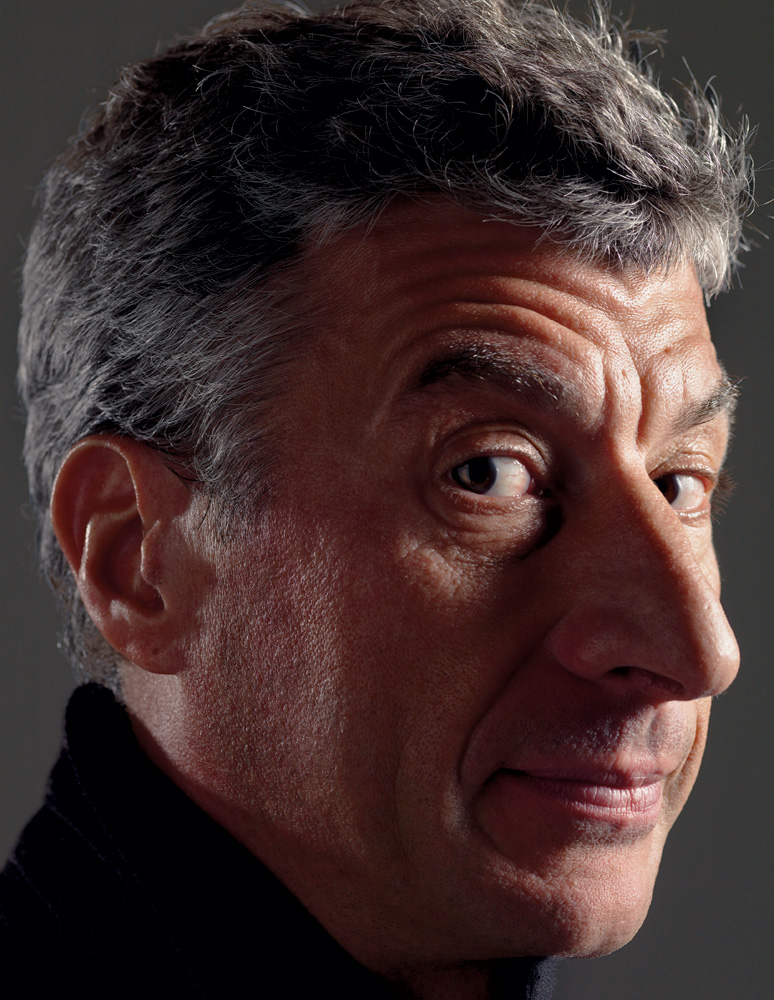
Best known for his facetious art productions, which are as surprising as they are unsettling, Maurizio Cattelan is the ultimate sideliner artist, poking holes in art, art history, monumentality, and nationalism. Take, for instance, Daddy Daddy (2008), the sculpture that Cattelan exhibited last winter at the Guggenheim in New York. A life-size, 3-D version of Disney’s Pinocchio floats face down in the museum’s rotunda pool and, in one gesture, seems to mock the forced optimism of the art world and the authoritative status of the museum. Of course, the 49-year-old Italian artist, who currently lives in New York, has been up to his tricks for quite a while. He described his co-curation of the 2006 Berlin Biennale, which involved looking at 700 artist entries, as an experience akin to “having a gun pointed to your head and smiling while waiting for someone to pull the trigger.” Cattelan speaks here about why the current political and economic climates could surprisingly turn into an opportunity for artists to reclaim their destiny.
MICHELE ROBECCHI: It seems like we’re living in a time where it’s essential to develop a strategy for survival. What’s yours?
MAURIZIO CATTELAN: I don’t think that the big crunch should be seen as a menace, but rather as an opportunity. It’s one of these times in -history—and we have plenty of examples from the past—where it’s possible to really make a difference. And if art is serious about claiming a central role in today’s society and culture, this is the best chance it’s had in ages. The current climate doesn’t represent a threat to the production of art but to the market. I think it’s time for artists to get over auction houses, galleries, and high-production-value exhibitions and start using our voices again.
ROBECCHI: Now, when you say exhibitions and galleries . . .
CATTELAN: I’m not talking about the intrinsic value of exhibitions. I’m criticizing the way they are perceived. I was going through a book of Marina Abramovic and Ulay’s 1970s performance work the other day. These people did two, even three Documentas or Venice Biennales over the course of a decade without any fuss. They would just treat it as any of their other engagements, with the same level of dignity and commitment they’d reserve for a one-day event in a small gallery on the Austrian mountains. Today, large-scale exhibitions are overrated. I’m not saying the 1970s was a golden age—I don’t believe such a thing exists in art . . . It would be like talking about a golden age of science. But it’s true that those were slightly more ideological times, and the relevance of artists wasn’t established by their CVs but by their work.
ROBECCHI: I agree about the market becoming too predominant, but at the same time, don’t you think artists could be partially responsible for this? After all, it takes two to tango. If the system was so rotten, you could have refused to play the game a long time ago.
CATTELAN: Part of the blame can be put at the artists’ door, too—no question. But I see our involvement more as a consequence. When there is too much money at stake, the whole system gets corrupted. Artists can be very vulnerable to these mechanisms.
ROBECCHI: Why?
CATTELAN: It’s in our nature. If you are a plumber, there is an objective way to establish whether you put together a great piping system or not. Art is a bit more slippery than that. So, when you fill a gallery with dirt and someone comes along waving wads of bills, it’s difficult not to take them because they become a tangible acknowledgement that what you’ve been doing actually makes sense.
ROBECCHI: Do you see this vulnerability as a relatively recent phenomenon? Or is it something in artists’ DNA?
CATTELAN: I think it’s genetic. Even during the Renaissance, it was all about where -artists were hanging out, who they were associated with, who would get the biggest commission. There are no exceptions. It’s pretty much the same with everything else, from architecture to sports. The only difference is that art, unlike sports or architecture, is not about supremacy or practical living. Art should be able to be innovative without compromising itself. That’s why I believe artists should have bigger preâ??occupations than checking the price tags on their work or becoming curators’ darlings.
ROBECCHI: How about curators? The way the art system is structured today, many people think that they’re the ones in a position to truly generate a change.
CATTELAN: Undoubtedly, artists have let curators take part of the burden off their shoulders over the years, but it’s a bet that doesn’t seem to have paid off. Because of their position, which is to act like some sort of catalyst between an institutional and a visionary world, curators cannot bring themselves to do the job. There are a few exceptions, of course, but in general, the vast majority of curators are more focused on the definition of their role and what this entails than anything else. Ninety percent of the panel discussions or roundâ??tables these days are all about formats. Have you noticed that? What’s the meaning of curating in the new millennium, what’s the role of a collector, how art fairs or biennials should be . . . They only talk about structure—almost nobody is talking about theory. And since nobody else is doing it, I think artists should. Who knows, maybe it’s time to write a new manifesto.
ROBECCHI: You sound very passionate, which is sort of a new color for you. How do you think that an experience like co-curating the Berlin Biennale in 2006 helped in shaping these ideas?
CATTELAN: Curating the Berlin Biennale with Massimiliano [Gioni] and Ali [Subotnick] was an eye-opener but not necessarily for the reasons you are suggesting. It was something completely new because of the level of organization and bureaucracy involved and because it allowed us to explore areas where we’ve never been before. But stepping out of the so-called limitations dictated by being an artist or a curator wasn’t a novelty for us. From The Wrong Gallery [a mini-gallery in Chelsea that Cattelan co-founded] to Charley [Cattelan’s art periodical], we always tried to do something different.
ROBECCHI: You just said the current economic situation should be seen as something liberating. When you started as an artist, at the end of the 1980s, a similar scenario presented itself with the art market suddenly going down the drain. How did you see it at the time?
CATTELAN: Looking back, it was a sobering moment as much as a missed opportunity. But I wasn’t so involved as I am now. I was too busy dealing with personal issues to focus on those themes. Here I was, in my late twenties, with no art education or anything like that, desperately trying to come up with something clever without making a complete fool of myself. I was so afraid of doing something wrong that I ended up spending a lot of time on my own. It was a character-building experience. I didn’t even consider myself an artist. To a certain extent, I still don’t. And I’m sure I’m in good company!
ROBECCHI: What makes you see it as a missed opportunity?
CATTELAN: The fact that, what we were going through in the ’90s was mainly a generational change, which was exactly what happened when Arte Povera tried to take over 20 years earlier, at the end of the ’60s. There was a group of new artists and new languages emerging, and the old guard was not very welcoming because of the threat they represented to their world. The difference in terms of economy and style was a big contributing factor in accentuating it, but, at the end of the day, what was happening was nothing new. It was just another generational turnover.
ROBECCHI: Well, there are some differences. In the 1960s, the generational turnover you are talking about wasn’t confined to art. Society, too, was deeply affected by this alternation. The 1980s were a relatively quiet time in comparison. Maybe the ’80s artists were rebelling without a cause.
CATTELAN: Opulence alone was clearly not a good enough reason to start a revolution. The art world was quite marginalized before the 1980s. Suddenly everything was going great, and I’m sure the last thing people wanted was to hail a Robin Hood free-for-all kind of character criminalizing success and fortune. It’s an awfully simplistic position to hold, too, unless you do it with intelligence or humor or some aplomb. Why would you want to be a party-wrecker? It’s more fun to try to hijack the party than to spoil it. And I found out very early in life that people tend to prefer the class clown to the class nerd.
ROBECCHI: Not to mention that sometimes the line between being a soldier and a revolutionary can be very thin.
CATTELAN: Yes. What I realized at the time was that there are three different kinds of revolutionaries: those who want to change things; those who are into the fight but couldn’t care less if things change or not; and those who work following their instinct, responding to a situation in a personal way that can end up having collective results—and that can affect the world a lot more. That last model is possibly the one I’m interested in most. Look at Gerhard Richter. Or Andy Warhol. Warhol was proof that you can be revolutionary without being militant.
ROBECCHI: Warhol certainly wasn’t an apolitical artist, as a lot of people would love to believe. Yet I’m not sure if his acceptance of certain values, like celebrity, was revolutionary in the way that you mean.
CATTELAN: In the long run, he was more revolutionary than a lot of artists who were openly championing the very same values that he was incorporating into his work. In Warhol’s work, serial repetition acts as a depowering or destabilizing force. He knew that believing in art as a society-changing weapon can be detrimental. There must be more to it than that. It has to be sensual, or witty, or visually appealing. The worst possible thing is when ideological art becomes didactic. What you get as a result is little more than propaganda—and then it doesn’t matter which side of the barricade you’re on.
ROBECCHI: How about your sculptures of John Fitzgerald Kennedy [Now, 2004] or Adolf Hitler [Him, 2001]? Aren’t these works plainly political?
CATTELAN: What I’m interested in are images. I’m sure you can tell. Who in his right mind would deliberately represent the pope struck by a meteorite in order to deliver a political message about the church? Or a hooded kid nailed to a school desk? It takes a very deviated and imaginative mind—say, Roger Waters in his The Wall period—to conceive something like that as a critique of the educational system.
ROBECCHI: And Lullaby [1994], the bags containing rubble from the bombing that struck the Padiglione d’Arte Contemporanea in Milan and killed five people? Wouldn’t you characterize that as a strong political statement?
CATTELAN: It got out of control. That piece was for a solo show in London—my first exhibition outside Italy, as a matter of fact. My initial idea was to present it like a snapshot of a determinate time, a modern postcard from Italy, if you like. It attracted a lot of criticism from the press, mostly because I was accused of airing the country’s dirty laundry in public. I was particularly stung by one piece in a national newspaper. It was written by an artist, someone you would expect to have a higher degree of sensibility on the subject, but his views were as poor and reductive as a tabloid commentator’s. His biggest concern, it seemed, was the good reputation of contemporary art.
ROBECCHI: He was probably thinking that your work was about being provocative or simply trying to cause a scandal.
CATTELAN: There are times when being scandalous or provocative can help bring focus to issues of major concern.
ROBECCHI: This year is the 100th anniversary of the Futurist Manifesto. Many people consider futurism and surrealism as the ultimate art movements that made a genuine attempt to change society. Both movements were masters at provocation. Where do you think they failed?
CATTELAN: Did they really fail? I think they are still very relevant today. Surrealism, and also dadaism, were pure gold. Maybe they got a bit carried away. Futurists were fundamentally fanatics, but I acknowledge that, in their madness, they anticipated a lot of what is going on today. Their blind faith in progress presents a lot of resemblances to all those people who are advocating a change through extreme ideology. What I find really funny is that futurists would be allergic to all these commemorative exhibitions that museums and curators are throwing for them. It is precisely what they were fighting against. The best way to honor their heritage would be to do something a little more outrageous and out of control than caging their art in a museum.
ROBECCHI: Many think that their supporting the war was their epitaph.
CATTELAN: Yes, but their concept of war was different from the one we have today. If you think about it, World War II was the first time in history where civilian casualties were more numerous than the military’s. Historically it was a massive turning point. It possibly set the model for all the wars we are witnessing today. The futurists were fantasizing about airplanes and missiles, but I don’t think they were fully aware of the implications. Their actual idea of war was very naïve and old-fashioned.
ROBECCHI: Right—horses and steel.
CATTELAN: Exactly. The people who were running it were total Evelyn Waugh characters. Nothing like what you would see today. War, like everything else, has become much more professional.
ROBECCHI: So you don’t think we are about to witness something similar to what happened in the 1930s?
CATTELAN: I don’t think the two decades are comparable. I don’t see the current crisis degenerating into a proliferation of totalitarian regimes. The crash of 1929 was a first. Unlike the current crisis, which was a long time coming, it was totally unpredictable. Nobody knew what was going to happen. Today we know that there’s light at the end of the tunnel, no matter how long it takes to walk through. All we need are exceptionally inspired people to set an example and guide us through the dark.
ROBECCHI: How do you perceive the wave of optimism following Barack Obama’s election running parallel to this fear of the crisis?
CATTELAN: It’s certainly an event of historical proportions, although a part of me can’t help thinking that we’ve all been mesmerized, that what is happening is the result of a mass hallucinatory phenomenon, and that, sooner or later, something dramatic is going to happen. I suppose it’s the pessimist in me. But if I should make an effort and be an optimist, I see Obama’s win as proof of what we were just talking about. It’s a return to more ideological values.
ROBECCHI: There are massive expectations.
CATTELAN: Yes. It seems like the whole world is lining up outside the White House holding bread and fish, waiting for him to perform a miracle. In a way, it’s a bit scary. But, at the same time, it’s kind of exciting, too. It makes you look forward to the future. You don’t get the opportunity to do that very often these days!
Michele Robecchi is a writer and curatorbased in London. He is also a contemporary-art editorat Phaidon Press, and a visiting lecturer at Christie’s Education.