


Kehinde Wiley


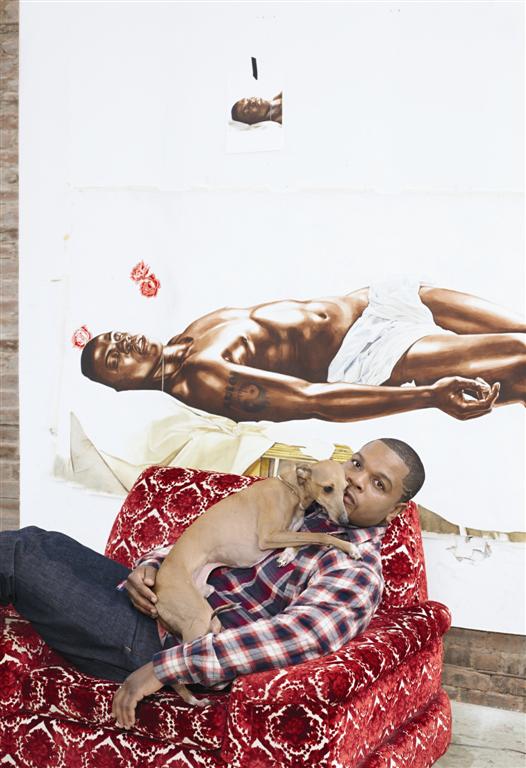
He’s a brilliant renaissance technician with hip-hop subject matter. His latest work focuses on young black men in a sadly familiar posture: Down. But in a world where bad is good, being down is not always such a bad thing.
The public perception of black male youth has arguably changed since artist Kehinde Wiley began painting his formal portraits while in residency at New York’s Studio Museum in Harlem in 2000. Part of Wiley’s process was lifting his subjects straight from the street and rendering them-complete with sneakers, track pants, tank tops, and team caps-in the visual language of classic European portraiture; the result wasn’t so much brashly iconoclastic as brilliantly inclusive, a mash-up of museum treasure and the urban life outside of its gates. What remains so surprising about these works today is that the 31-year-old Los Angeles native’s black males remain a rarity in the fine-art world, despite their prevalence, even dominance in pop culture. Wiley may have redefined portrait painting for a new century, but he’s still cutting his own path in a field that purports to be progressive.
Wiley’s practices have changed in the last decade and the results are increasingly visible. His recent show at the Studio Museum in Harlem called “The World Stage” took him all over the globe, from Lagos to New Delhi, to cast his models from the street and capture them in poses representing a larger world. His solo exhibition “Down” opens at Deitch Projects in New York City this month; “Down” features eight large-scale paintings of black youths based on iconic images of fallen warriors in art-from bullfighters to Christ. Here he talks about his work with his friend, fellow sampler, and pop star M.I.A. She managed to get stung by a bee during the interview, but the two still got around to tackling the demise of hip-hop and the death of the New York art scene.
M.I.A.: I wanted to ask you about the progression of your work these days. How are you finding it? Because New York is a really different place to make art compared to what it used to be.
KEHINDE WILEY: I came here almost 10 years ago now. It was my first experience of making a life for myself outside of school, and my career kind of snowballed at once. So there’s really not much in the way of an alternative experience for me to contrast it with. These days I’m spending quite a bit of time on the road, which finally has allowed me to get some perspective. I’m starting a new project where I open up studios in different nations and do street casting. I just got back from Brazil and Nigeria and Senegal. Actually, tomorrow I’m leaving for New Delhi.M: Does leaving New York change your art?
KW: That type of process becomes the work in many ways-physically removing yourself from what your work was based on before. By and large what I’d been doing was mining the streets of African America, using a sort of urban vernacular. That changes radically when you remove yourself physically, especially around the world.
M: Manhattan seems pretty developed, you know what I mean? Like it has peaked in culture. The Village Voice called it McHattan. It’s just become impossible for young, creative artists to live in New York.
KW: Where do you find it most fruitful to work?
M: I think traveling really helps. I know some musicians who have studios in Trinidad. There’s a collective of artists and painters there now who went to Central Saint Martins College [in London] with me. They live there and make art. It’s neat to see that-[people] not led by money or pretentiousness. It’s a small community, but you really have the space to observe and digest the culture. You go to a place where social commentary is rare and important and you can serve people. That’s what’s inspiring to me-finding someplace where people haven’t already seen themselves in a certain light.
KW: Yeah, I know.
M: You create that light, you create that visual or image.
In America, everything has been done. We’ve had everything. And now we’re rerunning what’s already been done.
KW: Right, recycling. The recycled object.
M: Exactly! I performed at a show at the MoMA. There was this big dinner there, and I was seated in this hall with the mayor of New York and all these extremely wealthy art-
supporting and art-buying people. There was a piece of work hanging in the hall-it was a fan. This fan was supposed to swing by the momentum of its own propeller. So, while we were having dinner, the fan was stopped, and the guy next to me, a curator at P.S.1, said, “Look, this is what art symbolizes today.” Like, that piece of art is supposed to be moving, but just to have dinner we’ve stopped the art. That’s what New York is like today. You can’t have real art happen in an institution because rich people can make the world stop. The stuff on the street is a lot more interesting.
new york, there is almost a feeling of entitlement by the public—this very palpable lack of surprise at being stopped in the street and being asked to be the subject of a 12-foot monumental painting.Kehinde Wiley
KW: I think so, too. There’s a freshness. I remember being in West Africa and thinking about my father’s country-he’s from Nigeria-and I was there, opening up a studio, doing a lot of street casting, stopping people, and there was this film crew with me because we were doing a documentary on my process, and I was contrasting the experience I had there with the experience I had doing the exact same street casting in places like the Fulton Street Mall, in Brooklyn. And it’s amazing how, in New York, there is almost a feeling of entitlement by the public-this very palpable lack of surprise at being stopped in the street and being asked to be the subject of a 12-foot monumental painting. I think part of that is mediated by a very televisual sense of instant celebrity, something that’s sort of “just add water”-an age where reality television mediates the way that we see new faces entering our lives. Whereas when I was in Nigeria, in places like Lagos and Calabar, there was a very ineffable exchange where these guys were really curious but also so far removed from this artificial environment that I was creating. It gave something new to the work. In some ways, there is a look in the paintings that seems a bit more fragile.
M: It’s like cinema, when you put someone onscreen who’s never been on before. You show it to them and say, “This is you. This is what you look like on a 60-by-60-foot screen.” It’s a different understanding of art. Take India: Even though it’s got a major movie industry, when it comes to contemporary art, artists on the streets don’t see themselves as artists-it’s like a skilled job. When they’re painting a car and they decorate it with all this crazy stuff, I think, “Wow, this is amazing! It’s something I would hang on my wall.” But they’re always really shocked when I go up to them and ask them to do something for me. Do you think that’s what you’re going for, looking for ideas outside of the disposable “just add water” kind of thing?
KW: My desire is to restart the conversation. It’s akin to this idea that most 18-year-olds who are going to be voting for the first time this year in the American elections were 10 and 11 years old during the 9/11 attacks-this idea that we’re all kind of collectively correcting and rebooting, this desire to throw away the old rules. This is something that, as artists, we constantly deal with-throwing away the past, slaying the father, and creating the new.
M: Yeah, change. You know, what really drives me mad about art is that, in America, the only thing you can do is to take it apart. As artists, that’s the best commentary you can do because there’s just so much vacuous content. For example, yesterday I stayed in bed for 24 hours and watched TV. I do that, like, every six months, where I just don’t answer phone calls and the only thing I do is watch television. And it’s insane! I couldn’t tell the difference between the news and an advert. It’s all Fox News, 30-second sound bites, and there was nothing I got from it at all. Where the fuck are all the Michael Moores in our culture? Where are the cool Democrats? Where are cool people on television? Where has cleverness gone?
KW: The trouble is that the traditional targets have been so co-opted. It’s hard to know where to cast your aim. So much of what changed American society in the ’60s had to do with a very strong set of targets-what we can physically do with ourselves and our bodies. Now it’s much more subtle. It’s almost debilitating in a way because we can’t organize either, artistically or politically or socially, against any specific thing, because it’s more like an essence, an ether that floats in the air, poisoning our ability to really have an authentic moment.
M: That’s what I miss, being a real human. Like, I’m just so grateful for the 10 years that I had in Sri Lanka when it was in the middle of a war and I was getting shot at, because now and again I remember glimpses of those times and I just go, “Wow, I’ll never, ever see that again in my life. And I’m never gonna feel that, and I’m never gonna feel for a human being like that.”
KW: When was the last time you were back in Sri Lanka?
M: Just before September 11th happened. After that it was insane to even try to go back, with all the new restrictions. When I was there I was already having a machine gun held to my head every five seconds, and every 50 yards I’d have to show my ID. I wasn’t a singer at the time-I was just a random girl, an artist. I was making films, and I had just graduated from Saint Martins in London. I thought I was invincible. Like, I’m getting harassed and I have a British passport. I have a letter from the Ministry of Defence! What if I were just a random Tamil girl from the village. I could be dead! It was the weirdest experience. I couldn’t even make a movie because you can’t make one without having it okayed by the Sri Lankan embassy. So you can only have a one-sided story. Do you think art in America is like all other industries? That there are certain parameters you can’t go past?
KW: Certainly. I think I’ve come through the art-industrial complex-I’ve been educated in some of the best institutions and been privy to some of the insider conversations around theory and the evolution of art. But that doesn’t necessarily get spoken about outside of a very small group. When you operate outside those rules, you are changing the vernacular. I think that’s partly the success of my work-the ability to straddle both of those worlds, the ability to have a young black girl walk into the Brooklyn Museum and see paintings she recognizes not because of their art or historical influence but because of their inflection, in terms of colors, their specificity and presence.
That’s partly the success of my work—the ability to have a young black girl walk into the brooklyn museum and see paintings she recognizes not because of their art or historical influence but because of their inflection.Kehinde Wiley
M: Yeah, that’s how I felt about your work the first time I saw it. It felt establishment, but it was also breaking it a little bit and twisting it. Do you feel a responsibility to teach something in your work?
KW: That’s a question I have always grappled with. Is that even my job? Is that gonna slow you down?
M: In the beginning I definitely felt a responsibility because I was representing a bunch of people who never got represented before. I felt this responsibility to correct that situation, to be like, “Look, you can’t discriminate against refugees and Muslim people and blah, blah, blah . . .” Now I don’t feel that so much . . . It’s complicated. Hold on a second. Are you there? I just got stung by a bee.
KW: Are you serious?
M: Yeah. It’s the first time I’ve ever been stung.
KW: You have to be careful with that. Some people have
major allergic reactions!
M: I know. I’m wearing flower-print pants. I think he thought I was a bunch of flowers.
KW: Drawn in by the flowers. That’s great.
M: Anyway, getting back, do you feel a responsibility?
KW: That’s a very complicated question. When I was growing up and going to art school and learning about African-American art, much of it was a type of political art that was very didactic and based on the ’60s, and a social collective. I feel sometimes constrained by the expectation that the work should be solely political. I try to create a type of work that is at the service of my own set of criteria, which have to do with beauty and a type of utopia that in some ways speaks to the culture I’m located in. But Americans are so overly fixated on racial identity-and on identity in general.
M: I know. As an artist I could either sit there with a chip on my shoulder and just chip away every day, or I could transcend all of it, which really makes it about what you’re actually saying-not being based on the burdens of the past but trying to make the world make more sense to you. If I actually had a chip on my shoulder and started, like, race bashing, they would have been more used to that. In school I was like, “I want to be a filmmaker.” And they were like, “Well, you can’t be a serious filmmaker if you’re not wearing a plaid shirt.” You can’t turn up at college in stilettos and say you’re gonna be a filmmaker. They were teaching me avant-garde filmmaking, where I had to make films that were, like, an hour long about nothing. [Wiley laughs] I just refused to do it, you know?
KW: It seems incredibly self-indulgent.
M: I just couldn’t be like that, because this week this is what’s happening in my life: So-and-so is going to jail, so-and-so got evicted, I’m getting busted for this, and blah, blah, blah. There was just, like, real-life shit going down in my house all the time. There was no need for me to go to college and learn how to film a blue screen for half an hour. I did my thesis on CB4 [1993]. Everyone freaked out. They tried to have me kicked out of school. They thought I was disgusting.
KW: I think there’s something important in going against the grain, and perhaps finding value in things that aren’t necessarily institutionally recognized.
M: Exactly! I want to find a taxi driver in India and ask him where he got the sticker that goes across his windshield. That decorative choice comes from the idea that maybe it’s good to tell your vehicle apart from everyone else’s when you get off of break.
KW: Right, very real.
M: They also do it because they want to show off. If they buy a shop, they’re gonna name the shop after their kid. If they drive a taxi, they name the taxi after their mom.
KW: This sort of reminds me of growing up in South Central Los Angeles back in the ’80s, you know, where so many people were flossing down Crenshaw Boulevard with their lowriders and hydraulics and stuff, and it was this major scene. For me it was always important to internalize that type of flossing. When I was at Yale, most of the students there were obsessed with this type of neo-minimalism that thought that any garish display or show of emotion or visceral beauty was something to be scoffed at. I think conversely it made me revert back to some of the more ornate or baroque features of black American culture.
At Yale, most of the students there were obsessed with this type of neo-minimalism. I think it made me revert back to some of the more ornate or baroque features of black American culture.Kehinde Wiley
M: That’s exactly what happened with me. Because I spent time in L.A., too, growing up on gangster rap. My cousin was a gangster bitch, and she knew the Bloods and the Crips and she was Sri Lankan, so we’d go to all these clubs down on Crenshaw. Then I would come back to college at Saint Martins, and I was learning a whole other way. Like having that whole ’90s hip-hop from L.A. and then going to Saint Martins, where it’s all the Britpop stuff about being shy and hating yourself. I was a Sri Lankan refugee, like, the scum of society, and then I went right to Los Angeles, into African-American culture, and it was just incredible. I’ve never seen black people like that in England. In England black people still live within the parameters of white society. It was an eye-opener. Then I’d be in school and the students would be like, “I’m white, and I’m male, and I don’t know what to do, I hate myself.” I was just like, there is this contemporary culture in America that’s writhing with so much good shit and bad shit that no one is really making art out of yet, you know?
KW: Sometimes there’s that tipping point, where societies -embrace who they are without necessarily needing a dominant culture or center to recognize the periphery. I remember being in Nigeria back in 1997 and meeting a bunch of MCs practicing their skills outside this bar and I was just like, “This is an amazing scene!” And how many people really know about what was going on in the hip-hop scene in Nigeria back in the early ’90s? These guys were really complaining about how they just couldn’t get any play at home and how most of what was consumed in terms of black culture was American. Of course, now you go to Nigeria and it’s a completely different scene. It’s just overrun with amazing acts. And I think that’s kind of indicative of a type of self-confidence that people develop when they recognize their own ability to create.
M: Yeah. Also, it could be the sort of declining grip of the American MTV-nation culture-the fact that MTV doesn’t play so much music anymore. When I would go to Africa I used to get really pissed off that people would listen to 50 Cent in, like, a mud hut and want DVD players and a GPS in their SUVs, you know?
KW: Now, why would that piss you off?
M: I felt pissed off because I realized that you have to teach people in a clichéd way how to be happy-and happiness has become too one thing in American media. Achieving happiness is not really about having a flat stomach and the best car.
KW: Personally-and this comes from my experiences of seeing people from very hard lives, working their way toward a sort of middle class, and really wanting to embrace the signifiers for success-the question has always been, who am I to tell them that that’s crap? You know, it’s not for me, perhaps it’s not my style but . . . [sighs] I know your feelings.
M: That’s fine! You can say, “Get the SUV,” but you can’t say, “Get the SUV before you get a house.” You know what I mean? Okay, there’s a kid in a mud hut. I don’t want to teach him bad habits because I live in Brooklyn. Brooklyn, New York City! And I feel like I’m living in the dead weeds of hip-hop. I live in the graveyard of what went wrong with hip-hop.
KW: Well, what went wrong with gangster rap?
M: It’s not even gangster rap-it’s just what’s wrong with hip-hop. It became so one-dimensional; itbecame like a businessman thing. It’s run out of creativity. It went so far off about making money that now everyone can do it.
KW: I wonder, though, because I think about this quite a bit when I think of someone like Jeff Koons, whom I admire quite a bit, but aesthetically this type of emptiness is the point-this type of soullessness and devotion to the signifiers of happiness and consumption. Are you prepared to say that that type of hip-hop-soulless, empty hip-hop-is interesting on some level?
M: Well, I would have said, “yeah, it was,” 10 years ago. But now I’ve had 10 years-
KW: [laughs] It’s not funny anymore!
M: Yeah, it’s not funny anymore. It’s good you’re taking your work everywhere and you’re making it global. I think all relevant work needs to be like that.
KW: One of the really great things about working in Lagos is that it’s such a crazy assault on the senses. The population has been rising since oil was discovered there in the late ’60s, but public sculpture has been there since even before the colonial years. All my models are asked to choose which pose they’re going to assume, and those poses are derived from portraits of former colonial masters or generals or military dictators or what have you, many of them cast in public squares. What comes out of people’s minds about which person they’d prefer to be, now that they’ve been asked to sort of open their eyes to what’s been there in their own backyard-
M: I have this artist I work with called Afrikan Boy. He was on my album, and he’s from Lagos, Nigeria, and he’s always like, “I want to be the African dream!” I think that’s so cool. I like the way he represents more than that modern outsider.
KW: If I were going to paint you, if I could paint you as any historical figure, who would it be? Now, you have to realize it’s all your look and feel, but I’m asking you about the pose.
M: A historical figure?
KW: And think about it in terms of a preexisting iconic work of art. For instance, when Ice-T came by, he wanted to be this really great painting of Napoleon by Ingres.
M: It’s really hard. There are so many people who -inspire me. I’ll have to think about it and e-mail you.
KW: Okay.