


John Currin


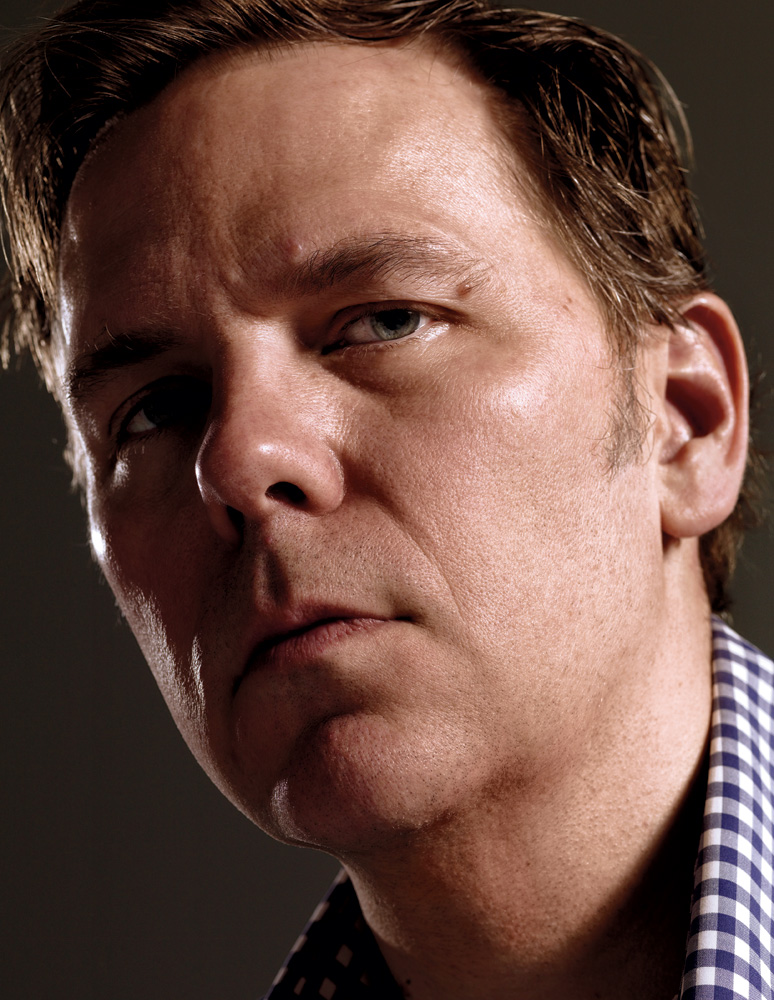
John Currin makes paintings that get people talking. In a time of widespread academic feminism, his paintings of voluptuous nudes came across as, perhaps, unexpectedly daring. And so was his masterful technique a breath of fresh and unconventional beauty in a time of bad painting fetching high prices. Currin has never been concerned with fashions or political correctness. From the beginning, he has set his own somewhat cantankerous course, and, fortunately for him, the world has come to appreciate his candor, his cleverness, and the talent that sometimes seems to afflict him. I interviewed him over lunch, the day after I did the same with his (very expecting) wife and muse, Rachel Feinstein.

GLENN O’BRIEN: Is the baby overdue? Is there a date when the baby’s officially supposed to…
JOHN CURRIN: Yeah, like, now.
O’BRIEN: That’s what I figured.
CURRIN: Well, the actual date was either Hitler’s birthday or Larry Gagosian’s birthday. But Rachel’s never really done it on the day it’s supposed to be . . . I think it’s gonna happen, like, tomorrow. [laughs]
O’BRIEN: After the first one, they tend to get easier, no?
CURRIN: I don’t know. The second one was harder. He was, like, stuck up inside. Rachel probably told you the story. It had to do with this little, like . . .
O’BRIEN: Vacuum, yeah.
CURRIN: Yeah, like a suction yarmulka thing that goes on the kid’s head—which always blows my mind because everybody’s always yelling about how you have to support your child’s head because their necks are very weak. Well, it’s like, “Uh-uh!” [laughs]
O’BRIEN: I have a big ridge in my head from the forceps. They pulled me out with, like, pliers.
CURRIN: Rachel has that, too. Rachel was born on an Indian reservation—so it was pretty low-tech. Her dad was in the Army medical corps. Instead of going to Saigon, he went to Fort Defiance, and so she has this funny lump. [laughs]
O’BRIEN: So, when did you know that you wanted to be an artist?
CURRIN: Well, I guess when I was 11 or 12. I mean, that’s what I was good at. My uncles were doctors, so I had some vague idea that it would be cool to be a doctor, mostly because they had swimming pools. [laughs] I thought, Hey, if you’re a doctor, you can have a swimming pool. But as soon as I could think rationally about it, I wanted to be an artist. I guess I thought I was gonna be an illustrator or something, because I didn’t really know that art still existed. I think I had this idea that it had kind of turned into naked hippies hangin’ out in their lofts. [laughs] You’d see Christo or someone like that . . . When I was a kid, I was more interested in album covers and stuff like that. I was studying violin, and my violin teacher’s husband was an artist. They were from the Soviet Union, and I started taking lessons with him. He couldn’t really speak English, but I started painting with him on weekends. He was a very good painter. He did traditional still lifes. He had a garret studio with a parrot in a cage. It really looked like a 1930s movie-version of a studio. The first time I saw it I was like, “Wow! This is what I wanna do.” Aside from the old masters, I had never seen somebody making good paintings before. So I realized that maybe there’s an actual art world.
O’BRIEN: Yeah.
CURRIN: I think at around the same time I saw some Francis Bacons and [Willem] de Kooning stuff as well—you know, contemporary art.
O’BRIEN: I saw a documentary about Jack Levine and they asked him what made him want to become an artist, and he said that he found out you could draw naked women and get paid for it! [both laugh]
CURRIN: He’s pretty much right on the money there.
O’BRIEN: So what was your earliest work like?
CURRIN: Copies of my teacher’s stuff. And then I made some sort of Frank Frazetta naked girls that I didn’t show my teacher. I did still life and anatomy and copies of Degas that he would give me to copy—you know, drawings out of books.
O’BRIEN: Frank Frazetta—is he an illustrator?
CURRIN: Yeah, he’s like Conan the Barbarian. He’s the originator of the style that’s now sort of standard. Do you remember the Clint Eastwood movie The Gauntlet [1977]?
O’BRIEN: Yeah.
CURRIN: The movie poster was done by Frank Frazetta. It’s the hero standing atop a hill of either corpses or tires or something, with a babe kind of collapsing onto him.
O’BRIEN: Sondra Locke collapsing, yeah.
CURRIN: But he’s actually very good. And when I went to college, and I went to art school, I started to realize that Warhol was cool and that pop art was fun. But it was kind of gradual, because in my high school, there was certainly no acknowledgement that you could become an artist or anything like that.
O’BRIEN: When I was in high school, the idea of becoming an artist was that you could go work for Mad magazine.
CURRIN: Oh, yeah. That would’ve been pretty great, actually! [laughs] There would have been no shame in that.
O’BRIEN: I was thinking about erotica in my youth, and I remember looking at nudes in the Encyclopedia Britannica—black-and-white plates of marble statues of nudes. What was your first experience of erotica?
CURRIN: My mom had a large collection of Coronet, which was kind of a general interest and art magazine.
O’BRIEN: It was a small size, right?
CURRIN: Yeah, and it changed radically at some point. It became family-ish. But before that, it had amazing Paul Outerbridge pictures and European art-photography, nude photography. And there were all kinds of general interest articles. There’d be, like, a pro-Mussolini article, like, “What an amazing man of action,” you know, “Pilots his own plane . . .” And then, “How to Have a Good Conversation”—sort of high-minded American stuff. There’d be an article on Meissen porcelain . . . that kind of thing. And so those had a lot of nude women in them.
O’BRIEN: It’s funny, I hadn’t thought of that since I was a teenager, but my parents got Coronet, too. I remember one particular photo with a nude girl in stockings with her legs crossed, holding, like, a champagne glass. But it was okay because the photographer was an important artist.
CURRIN: Yeah. We also had an Eadweard Muybridge book. Most of the women in the photographs are not so great-looking. But there are a few amazing-looking dancers. I used to look at that a lot, and I think my uncle the doctor had some Playboy magazines.
O’BRIEN: So when did you first paint a nude? When you were studying with the Russian?
CURRIN: No, I didn’t have a model then. I guess when I went to art school they had models. And they did their best to make it not something you look forward to. It’s, like, early in the morning, and it’s six hours long. And you fall asleep looking at this person, and it’s not very erotic.
O’BRIEN: And the models were probably pretty gnarly, right?
CURRIN: Sometimes there’d be surprisingly great-looking models. There was this one redhead at Carnegie Mellon who was great-looking, andat Yale there were fantastic-looking models. A lot of the acting students would do modeling in the arts school, so there were some gorgeous girls, but the cliché in our school was to get either the really emaciated person or the really obese person—which is stupid, you know? The idea is to get you to be able to draw. It’s better to have good-looking people. But you’d often have the semi-homeless guy—which would be awful, you know? Especially if they got erections while you were drawing them—which is just totally gross. But I didn’t start doing nudes until I was in art school, and I tried to do, like, de Kooning and Polke and Schnabel. I tried to work like that.
O’BRIEN: Rachel said that you did abstract painting for a while.
CURRIN: It wasn’t really until after I got out of art school that I realized that I’d been doing that sort of for the audience, for that context. Somehow, being alone in the room, it made no sense at all to make those kinds of paintings.
O’BRIEN: But when you started on the path you’re on now, that was really the most unfashionable direction you could take, right?
CURRIN: I guess so, but it didn’t feel that way at the time. In some ways it felt like almost the opposite, like it was surprisingly easy to get attention and be different. This is sort of a glib way to put it, but it was sort of like doing conservative paintings with a straight face.
O’BRIEN: Yeah.
CURRIN: All of sudden everybody got worked up—which is far from being an unfashionable thing or bravery.
O’BRIEN: Yeah.
CURRIN: So it’s getting a reaction, you know? Part of it was just taking the people who I had liked a lot—David Salle and Schnabel and Polke and Kippenberger—and changing the format slightly. Instead of layered physical space, I kind of layered culture. You know, different languages battling on one painting. I thought an interesting thing would be to make it kind of authoritarian . . . [laughs] You know, one language, one image, one source of meaning—more of a boring thing. And I had seen an interesting
way to kind of hide the ball with my influences. I’d also seen -[Francis] Picabia, and Picabia made all these paintings of Spanish ladies—which I thought were totally fascinating, weird things. And I was always fascinated with Neue Sachlichkeit [the New Objectivity] and Christian Schad, this German realist from the ’20s and ’30s. I loved the weird, out-of-step-ness of what they were doing, and you couldn’t figure out where they stood politically and whether they were modernists at all—whether they were some sort of right-wing modernists . . . I also read this book around that time by [Percy] Wyndham Lewis. He was a Vorticist . . .
O’BRIEN: I’m sort of a Wyndham Lewis nut. I love his writing and his painting.
CURRIN: So you know who I’m talking about. I read this book . . .
O’BRIEN: The Demon of Progress in the Arts?
CURRIN: No, I read, uh, Tarr, and it just blew my mind.
O’BRIEN: Yeah. It’s amazing. We’re supposed to think only of Joyce as modernism. Lewis isn’t in the canon.
CURRIN: And because of it, I realized that there was another half of modernism that was completely hidden, because it had sort of lost—
O’BRIEN: The struggle for art history, because it had some fascist associations . . . Wyndham Lewis shouldn’t have said those things about Hitler. [laughs]
CURRIN: Yeah, yeah. [laughs] He was misquoted.
O’BRIEN: Lewis took it back. Hindsight is 20–20.
CURRIN: Hitler was what Europe needed. [laughs]
O’BRIEN: Or vice versa. But that was pretty early. Lewis took it all back.
CURRIN: He had to go to Canada, right?
O’BRIEN: Yeah.
CURRIN: But just to see modernism through a fascist lens, and that sort of social good, the progressive social good that’s always laid on LeCorbusier and modernism, and just on modernism. You realize that it was superfluous. [laughs]
O’BRIEN: Well, Le Corbusier is represented as an idealist, but he was invited by Mussolini in ’34.
CURRIN: There is a fascination with violence and power in all modernism, and I sort of saw classic modernism as being more similar toWyndham Lewis than to the Renaissance. It’s not about flow and the presence of humanism and all those things. People like Picabia became much more important to me when the perversity of the whole 20th century started to become prominent to me.
O’BRIEN: Yeah, I think that history hasn’t really been settled.
CURRIN: And so the rearguard feeling of figurative painting—the unprogressiveness ofmaking a figurative painting—didn’t bother me anymore. It’s not like I got enabled by a fascist, but much the same way that I stopped structuring my paintings as abstract paintings, I realized that subject matter does not matter. Or it matters the least. And especially interesting subject matter—that’s the worst. So that was kind of another way to stand out, to play it straight. Or if you do something interesting, then make it ham-fisted, try to fool the smart people—you know, fool the priests. That’s a long way of answering. It wasn’t unfashionable in any kind of daring way. It was just exactly what I was dying to find.
O’BRIEN: I think it was daring to take up the genres that had been made taboo by the success of minimalism and conceptual art that dominated the critical establishment. When Warhol was doing portraits, it was really unfashionable to do a portrait.
CURRIN: Right.
O’BRIEN: Especially a commissioned portrait. The still life was completely out until some brave souls started doing it again at the end of the ’80s. Wyndham Lewis’s book The Demon of Progress in the Arts is basically a very reasoned rant against modernism and how extremism was leading to the end of art. The idea that there is progress in the arts in the same way that there is progress in science is absurd. You get to what he called “the point beyond which there is nothing.” Art is evolutionary, in that it responds to the times but it doesn’t improve.
CURRIN: Yeah, it’s like being alive. It’s not superman that you’re making. Another big realization for me was: Just don’t do things that depress you. I realized if it depresses me, then I just don’t want to get close to it. If it brings me down, I just really can’t get into it. I think a big problem with art school is that it makes people feel like they have to be interested in everything that’s of high quality.
O’BRIEN: Yeah.
CURRIN: Donald Judd’s work is high quality, but it depresses me. And so immediately I could just say, “I don’t have to worry about Donald Judd now.” [laughs] It’s great. And I think a lot of people take a more scholarly approach where they feel like you’re supposed to study things that depress you.
O’BRIEN: Yeah.
CURRIN: But I think there’s not enough time to be interested in those things. And there’s so much that doesn’t depress me. There are aspects of repetition that also depress me. Seriality depresses me. Performance depresses me. Lack of narrative depresses me. All those kinds of cool things bring me down. So that was an important development for me, just realizing that you need to follow your pleasure, at least as a painter. I think any kind of artist needs to, no matter what you’re doing.
O’BRIEN: I looked up your Wikipedia page.
CURRIN: [laughs] Oh, god.
O’BRIEN: And it said that you’re a satirist. I don’t know how you feel about that. I mean, Wyndham Lewis was called a satirist, and I guess in his writing he was, in some ways, a satirist, but as a painter he wasn’t. I would never call your work satire. But for you, is there a satirical element in it? I mean, there are big boobs, but . . .
CURRIN: It’s not ironic. It was a conscious effort to—instead of being critical—just mock. [laughs] Or, instead of being critical, to do a caricature.
O’BRIEN: Yeah.
CURRIN: I always try to use this metaphor, and nobody ever understands what I’m talking about, but it’s like Jay Leno’s humor versus David Letterman’s. Jay Leno does this thing like, [imitating Leno] “Doncha hate it when . . .” So the joke is over already, it’s so overexplained. In other words, he distances himself from the thing that’s gonna be funny. There’s nothing worse than people talking about theories and humor, but I would say that I would be more like Leno than like Letterman, where it would be a caricature that sort of signals that this is going to be the funny part or the critical part. I thought that was more conducive to what I was trying to do—it fits in better with oil paintings than a completely ironic approach and being completely undercover. So I suppose I’m closer to David Levine, the illustrator from The New York Review of Books, who puts big heads on small bodies. In fact, I did a painting of Nadine Gordimer with a gigantic head. It’s like this intellectual whose head is expanded, because, partly, that’s the possibility of painting—it’s always an affirmation.
O’BRIEN: Yeah.
CURRIN: The feeling I got was that a painting of any quality is always going to have nerdy energy, an affirmation behind it. It’s gonna be like a kid playing a video game.
O’BRIEN: Pure enthusiasm.
CURRIN: Painting is like that much more than it is like being a lawyer and attacking a corporation, you know?
O’BRIEN: Yeah, that’s exactly the problem I have with calling your work satirical. If I look at Bea Arthur Naked, for example, that’s a very funny idea—there’s an ironic notion to that. But then if you actually look at the painting, there’s something very sympathetic about it. Because she’s somebody who scared me. If I were trying to find an intimidating female figure, at a certain point in my life I probably would have said Bea Arthur. Then you took her and, in the middle of a very funny idea, you found something human in her in that painting. It’s like you took a perverse idea and made it transcendent in the execution. It’s almost redemptive.
CURRIN: Yeah, and it’s also her fame. I mean, that was the funny thing—just the weirdness of having that as a celebrity face. Bea Arthur had a presence in my head. I had made a drawing of her long before that, when I was making abstract paintings.
O’BRIEN: Yeah?
CURRIN: And I remembered that drawing of Bea Arthur, and I found a picture of her, and I kind of copied and generalized that picture into a Soviet portrait of Bea Arthur, her eyes being black circles, and then I thought the breasts would be . . . that it would be like a Gorgon, you know, a terrifying Gorgon, and then a mother as well. But another, simpler way to put it is, whatever I’m painting, if I’m painting you and I’m painting your sleeve—it’s a gray knit sweater.
O’BRIEN: Yeah.
CURRIN: I have to like the fold in the sleeve. If I paint that sleeve in a painting, I have to like that sleeve. You have to like everything that you’re painting. Maybe on a narrative level it seems harsh . . . but I like everything in all my paintings. It’s as if you need to be less intelligent at that level.
O’BRIEN: One of my favorite quotes from Warhol is: “Pop art is about liking things.”
CURRIN: Well, that’s a profound statement.
O’BRIEN: People thought that Warhol was really taking the piss and being caustic, but he was taking things that were sort of ambivalent and embracing them.
CURRIN: And when you see the tremendous energy that’s in those things, which he always does as a kind of trick, because he had somebody else to pull the silk screen . . . But this idea of being completely standoffish masks this tremendous energy and love for every single thing that he makes.
O’BRIEN: Yep.
CURRIN: And it’s never critical art. I wonder whether there is such a thing as critical art. I suppose there are portraits of people who could destroy you. I mean, like Velázquez painting Pope Innocent X as a frightening child molester, or whatever the hell he looks like . . . [laughs] But a big part of moving toward that kind of figurative painting was, for me, there was a lethal laziness and a lack of probity in the context of art in the ’80s and ’90s. I mean, the main heavy lifting was done by Salle and Schnabel and Clemente and those people, because that horrified everybody from the early ’80s. That was really fun. I mean, as an art student, it was really fun to see them. And they’re all good artists, but a lot of them made just god-awful painting—embarrassingly terrible art. And that was the other thing: It was just a spectacle of people making unbelievably terrible art at a high level.
O’BRIEN: Young people today probably don’t understand that moment.
CURRIN: Real embarrassments, you know?
O’BRIEN: Painting was so out. That’s why hundreds of little galleries opened up, because the mainstream art world was so aligned with minimalism and conceptualism that it would never have accepted that freedom. The museums and academia had made painting outré. The conceptualist victory was so complete that a new infrastructure had to be improvised.
CURRIN: Right, they were busy turning art into something like modern music. It exists only in your universities and only WQXR wants to play it. It’s like American Masters on Channel 13. Nobody likes it, nobody listens to it, and beyond, like, Koyaanisqatsi [1982], it doesn’t show up anywhere in culture. So those people being willing to be bad artists as well as good artists was amazing. It brought taste back into it. It brought all kinds of messiness. It sort of brought sex back into everything. I was watching Fanny and Alexander [1982] recently. The movie is in two halves, and everything’s great with the kids until they have to move in with this bishop, who is this sadistic guy. And I’m realizing, most of the art world would prefer the bishop. They would think that his house was awesome.
O’BRIEN: Yeah.
CURRIN: They would think with that ice-cold waterfall in front of it that he has better taste than—I don’t know what they were—Catholics, and their homey
brocaded chintz house. You realize there is so much a culture of self-denial and asceticism. And it’s fine for other people, but those moments don’t last long. And maybe they’re very special because they don’t last long, but vitality never lasts long in reduction. It’s like if Savonarola was never burnt at the stake and he took over. Botticelli was
fantastic until he took up with Savonarola. I mean, he’s still great, of course, he’s a genius. But it’s so sad to see what happened to Botticelli.
O’BRIEN: After the Bonfire of the Vanities . . .
CURRIN: And people say, “So much bad art got made in the ’80s.” Well, it’s better than what would have happened if the only people willing to make embarrassing art were Judy Chicago or people like that.
O’BRIEN: Well, it was risky art. Some of it was bad, but a lot of it was great. If people had taken the safe way, nothing would have happened.
CURRIN: Not the safe way, but the way of the book.
O’BRIEN: Yeah. [Discussion of the excellence of the food at Il Buco, the restaurant where they are eating, in downtown Manhattan]
O’BRIEN: I think the financial crash sort of altered the way I see art, not in general, but in specific instances. Like walking through Art Basel in Miami, I’d find that something that looked like art the year before didn’t look so much like art anymore. Obviously the work hadn’t changed, but the lines were redrawn. It seemed like the cooling market reaffirmed more traditional values.
CURRIN: Really? I think it’s almost the opposite.
O’BRIEN: Really? Don’t you think labor intensity and talent look more important now?
CURRIN: I don’t know about labor intensity. In fact, I think, if anything, there will be a collapse in the value of labor intensity. This is a weird moment . . .
O’BRIEN: ’Cause we’ve been living in a gestural world.
CURRIN: I don’t want to sound more philosophical than I mean to, but it’s a huge thing when people realize across the culture that paper money is paper. And that there’s no fixed value—it’s all political. That all value is set by a political authority, basically.
O’BRIEN: Or systems of belief.
CURRIN: And there is, literally and figuratively, not a gold standard. That’s almost as big a problem in art as in the financial world. How do you affix a value to something that only has value because a certain number of people agree to believe in that value? Maybe ultimately that’s a spiritual question, but our lives run on it. And I’m not sure that labor intensity is gonna be determining that.
O’BRIEN: No, I just think it’s one factor. And maybe it’s more relevant to the art you’d see at SCOPE than at Basel. But now that the system of financial instruments has collapsed, gold is at an all-time high. So what’s the gold standard in the art world, you know? It’s beauty and craft and . . .
CURRIN: I wonder if it is, though. I’m too old now, but I can imagine that the person who can do the bullshittiest show now would be something. I think that would be good, if you were young.
O’BRIEN: That’s like trying to cash a really big check, though.
CURRIN: This would be a good moment for somebody to hype the most laughable check of a show that they could possibly get away with. It would be fun to see someone do. And not a wry comment on the evil corporation, not the usual kind of leftist, standoffish take on things. I think it would be interesting to make something where you didn’t know whether it was any good or not. I’ve been interested in that for a while and I haven’t been successful at it. But with the idea of bad drawing, for instance—the gold standard of no value is crummy drawing. ’Cause it’s what everybody can agree on, what they don’t like. I was trying to make things that had really terrible drawings. Not just bad drawing, not just low-quality drawing—but really, really shitty drawing, really terrible drawing. And that originally was why I got interested in pornographic images. I thought it would be interesting to do porno drawn really poorly. To sort of double disappoint. I still think it’s an interesting idea, but, again, it’s only an idea. Every time I try to make a bad drawing, either I don’t make a bad drawing or I make a bad drawing and it’s just so terrible to have a bad drawing in front of you . . . [laughs]
O’BRIEN: Well, who’s good at it? I mean, that’s the modus operandi of Kippenberger and Albert Oehlen and—
CURRIN: Kippenberger, I think, was able to make bad drawing really well. There was a criticism of—I think it was Richard Serra—about Picabia. I totally disagree with him, but in a way he had a point. He said that all Picabia proved was he could make bad paintings that stay bad. It’s an interesting idea, and, in a way, I was very hostile to him for saying that. And then I thought, But he is kind of right. There is something special about bad paintings that stay bad, like, 60 years later. Not bad because of their taste or because of a political problem, but they’re actually bad, by somebody who’s really good. It’s an aggressive and complex style as a result. Something’s
happening there.
O’BRIEN: Well, what would be an example of that for you?
CURRIN: Picabia.
O’BRIEN: Yeah.
CURRIN: And Dosso Dossi, and many older Italians, and many Germans. You know, it’s very subtle. You have to look at these things a lot to see it. I mean, Hans Baldung could draw like Dürer if he wanted to. But he could also draw like somebody you can’t believe would draw that way in a painting. Dosso Dossi is the most shocking—he’s kind of a follower of Titian, and one of my favorite artists. And he’s so awkward and so masterful simultaneously that it’s just pure magic and very, very beautiful.
O’BRIEN: What was his intention?
CURRIN: I have no idea. [laughs] I think a kind of forced poetic feeling—Rococo artists can be that way.
[Freize co-founder Amanda Sharp and Warhol Foundation president Joel Wachs appear and talk about babies, etc.]
CURRIN: So an interesting question from Miami was, how on earth do you value art? Of course, in a capitalist system, things are valued by what people will pay for them. And you only get into trouble when you determine that an authority shall assign a value, which is exactly what the problem is with these securitized mortgages—that the U.S. government has to say are worth something. Nobody knows what they are worth, and that’s the problem with the banks. Nobody knows whether these banks are even banks anymore. And so, in a funny way—not in a funny way, in a terrifying way—there’s an allegory for most aspects of life, it takes place on faith in one form or another.
O’BRIEN: It’s faith and there’s an element of conspiracy to it.
CURRIN: [laughs] Well, same thing, right?
O’BRIEN: Which is why, when people say that the art market will shrivel up and die, I always say no, because the art market is the most opaque and ungovernable market that’s ever been conceived.
CURRIN: I hope it stays unregulated.
O’BRIEN: It’s the perfect market for speculation because it’s inscrutable. Governments could never figure out how it works. I mean, if they can’t understand banks . . .
CURRIN: They could just outlaw sectors of it. I hope Sauron’s Eye does not wander over to the art world.
O’BRIEN: If they can’t figure out Wall Street, they’re never gonna figure out the art market. The art market doesn’t have derivatives . . . [Currin laughs] Or does it?
CURRIN: What the hell else is a work of conceptual art but a securitized idea?
O’BRIEN: I wonder if dealers are selling futures.
CURRIN: It’s when people figure out how to sell art short that we have to be worrying. [laughs]
O’BRIEN: Isn’t that what Saatchi’s done?
CURRIN: In a way, yeah. Well, no, I don’t know if anybody has figured out how to make money off art losing value. But that seemed to be the elephant in the room at Miami—what the heck is anything worth? It’s not all worthless, you know?
O’BRIEN: Yeah.
CURRIN: I don’t think that there’s any way you could say that it will have to do with just simply adding value by repetitive hand motions or something like that. I hope so—that would be great for me.
O’BRIEN: I just felt like I saw more things that had this sort of primitive wow factor, like, “Wow, that must have taken a lot of people a long time.”
CURRIN: Yeah, like prison art, where it’s like, “Wow, you made that all out of toothpicks,” or something like that.
O’BRIEN: Yeah, it’s kind of like trickery . . . Well, I think that there’s still that element.
CURRIN: I think that’s just conservatism really. All I know is that I don’t wanna acknowledge it. I think my strategy is going to be to put on a happy face. [both laugh] There are these ridiculous cycles in the art world of shame and exuberance, shame and exuberance. And also embarrassment and righteousness, embarrassment and righteousness.
O’BRIEN: Yeah.
CURRIN: I suppose the good artists, the righteous artists, somehow manage to be exuberant, and the embarrassed artist has this idea that everybody has to stop being so excited, which I find so distasteful. That idea that we should recycle instead of make art or something like that . . . I don’t know. [laughs] We all have to go to a monastery now, everybody’s getting religious.
O’BRIEN: Yeah, leave the diamonds at home.
CURRIN: It must be terrible in magazines, because magazines are all about exuberance. It’s all about excitement and exuberance.
O’BRIEN: Yeah. Well, we haven’t done a shame issue.
CURRIN: And when everybody is saying, “You shouldn’t be this way at a funeral.”
O’BRIEN: The rich just aren’t in the mood to shop.
CURRIN: But that’s also a great opportunity, I guess.
O’BRIEN: I think we have to carry on as usual. Eat more pasta.
CURRIN: So instead of last man standing, it’ll be last man smiling.
Glenn O’Brien is Interview’s editorial director.