


Jeff Koons


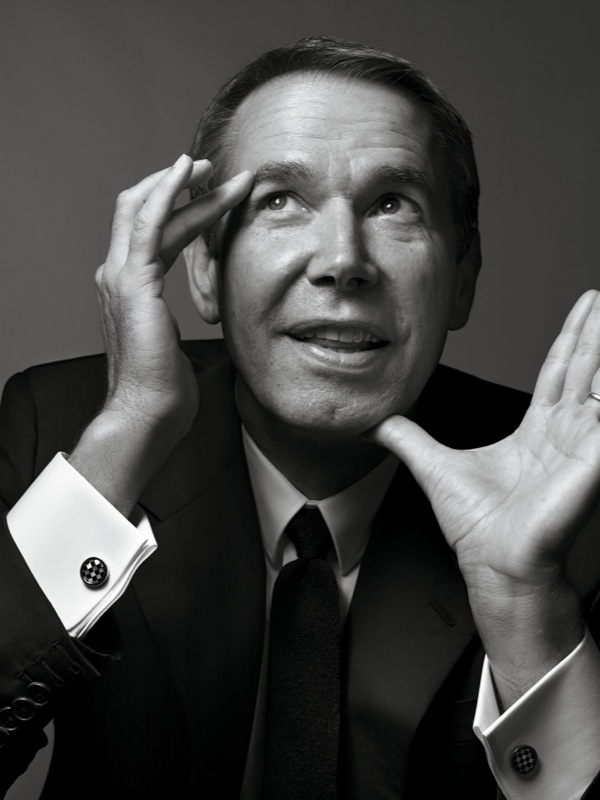
Just a few months ago, the art world watched in shock and awe as Damien Hirst skipped his gallery to hold a mammoth auction of his own work in one of the ballsiest and most successful displays of showmanship since Jeff Koons made life-size porcelain works of himself going at it with his then-wife Ilona Staller, a.k.a. La Cicciolina, back in 1989. Nearly 20 years later, long after that marriage went south and Staller fled the United States with their son Ludwig, Koons has moved on to a new plane entirely. A rare show of his “Celebration” sculptures opened in October in Berlin; one of his enormous “Balloon Flower” sculptures is the first piece of public art at Ground Zero; and his immense 161-foot-tall train-from-a-crane is on track, so to speak, to be built at the Los Angeles County Museum of Art. Most fascinating of all, this all-American artist enthralled (and roiled) la France this past fall when his first European retrospective went on display at none other than the Palace of Versailles, making him the first contemporary artist to be given such royal treatment. Sitting down in his amazingly colorful candy factory in West Chelsea, New York, Koons talks about how he hates the word kitsch, finds irony useless, and loves the films Bambi (1942) and Goldfinger (1964). And while the boy from the Rust Belt is as American as a Hershey’s Kiss, it turns out he has more in common with Louis XIV than with Henry Ford.
———
DAVID COLMAN: How did the Versailles show come about? Was it generated by you?
JEFF KOONS: No. Several years ago, a friend of mine, Jérôme de Noirmont, who’s a gallerist in Paris, said, “Wouldn’t it be great to make an exhibition at Versailles?” And I said, “That would be great.” Because when I made works like Puppy or Split-Rocker, those large floral sculptures, I always thought that they were the types of works where Louis XIV would wake up in the morning, look out his window, and fantasize about making something like that-you know, he’d want to come home that evening, and there it would be. So it turned out to be a treat to have that take place. We talked about it for years, but actually when Jean-Jacques Aillagon, who was the minister of culture and communication in France, became president of the Château de Versailles Museum, there was discussion about incorporating contemporary art into Versailles during the year. And so Jean-Jacques said, “Let’s invite Jeff.” But there’s been this underlying idea for the last couple of years among some friends in France that it would be great to show my work in Versailles.
COLMAN: In some ways it seems so perfect for Versailles, and in some ways it seems so completely wrong. You know I say that with love. But it has this great monumentality and reflection and this over-the-top ornamentation that is so perfect for the environment, and yet at the same time it’s so American. Obviously these adjectives are open to discussion…
KOONS: I think that it worked kind of perfectly. I’m interested in sensuality. I’m interested in power. I’m interested in the kind of polarities and equilibriums that take place within sexuality and philosophy and sociology. So in Versailles, in this type of setting, you have a place that is about absolute control, where everything has been thought about.
COLMAN: Which is very Koonsian, I must say.
KOONS: Well, certain aspects of it-I like to pay a lot of attention to things. There’s another aspect that then comes along, which recognizes that even when you exist with all of this control, there are certain areas where you do, in the end, have to give it up.
COLMAN: I don’t believe you ever give up control.
KOONS: Well, in these sculptures, like Puppy or Split-Rocker, there is a point where you do. Whenever you finish an artwork and the viewer comes and views it, at that moment you’ve given up control.
COLMAN: So what was the reaction? I heard there were some French people who thought, Oh, this American person shouldn’t be showing at Versailles, blah blah blah. They go off on that tangent pretty quickly.
KOONS: I heard about these things and didn’t get so involved in that dialogue other than to let people know that I just wanted to make something very positive at Versailles. But walking through the exhibition after it was installed, I noticed that some of the guards would be walking around huffing and puffing, you know, “How can this be here?” They were upset by it. But actually people say that in France it’s really having quite an impact. They’re getting very large crowds coming and that it’s somehow hit a nerve within French culture where they can have a dialogue about contemporary art and historical works and the decorative arts of the past. I’m interested in sensuality. I’m interested in power. So in Versailles, in this type of setting, you have a place that is about absolute control, where everything has been thought about.
COLMAN: Walking around your studio, the kind of creative genius that comes to mind isn’t Louis Quatorze but Willy Wonka. Do you remember that movie [Willy Wonka & the Chocolate Factory, 1971]?
KOONS: You know, I did see Willy Wonka a couple of times, but it was never my favorite film.
COLMAN: What was?
KOONS: It depends how young I was. I always liked Disney films. To this day I think Bambi is great. But Willy Wonka was one that I never liked so much.
COLMAN: What didn’t you like about it? I mean, there’s just so much-especially the chocolate room. Just walking around there, it’s an incredible dream machine. All these various stages and rooms and people and things going on . . . It’s amazing.
KOONS: I don’t know, I guess there was some aspect of the movie that I didn’t connect to completely. I don’t know if I found it scary . . . I do like films that connect, that are positive . . . and I don’t really eat a lot of chocolate myself.
COLMAN: It’s not necessarily a feel-good film.
KOONS: No. When I got a little older, I remember seeing my first Bond film with my father, and I enjoyed that. It was good, Goldfinger.
COLMAN: Oh yeah, of course.
KOONS: I show that film to my kids today, and they talk about Goldfinger getting sucked out of the plane.
COLMAN: Oh, right, right. What’s the crazy one, where somebody’s forced to swallow one of the exploding air pellets and he becomes inflatable?
KOONS: I didn’t see it. But that’s good. Appropriate.
COLMAN: You love inflatable objects, that’s for sure. Do you still shop a lot for toys?
KOONS: No. When I was younger I used to. I would shop on 14th Street in New York and I’d be looking for a lot of visual information that was product-oriented. But over the years I became more involved in connecting to things that are archetypal and profound, things that connect you with human history. I spend much more time looking at art history and at different references to art than I do at actual objects.
COLMAN: Let me ask you about the train-hanging-from-a-crane thingamajig planned for the Los Angeles County Museum of Art. How’s that going?
KOONS: The train, the sculpture, a public piece, will be created for outside LACMA-for what they call the campus there. We finished our phase one and phase two engineering, which means we’re ready to build. All the designs for how to make something like that actually function and be able to be maintained and workable are finished, so it will hopefully be built in about three years. We’re very optimistic.
COLMAN: It would be good to have something like that in the L.A. skyline because there’s nothing there.
KOONS: What I like about the piece is that it functions like a kind of European town center to rally people around. I think philosophically it brings people into contact with their own sense of mortality. It’s very visceral-a kind of sensual, sexualized performance that takes place with this powerful steam engine starting up and running and building momentum.
COLMAN: So the wheels will turn?
KOONS: Well, everything that a real train does this train will do-but it’s hanging, you know, facing straight down to the ground. It’ll start heating up and steam will leak from one valve and then you’ll hear, like, a ca-chunk and it’ll go into a gear. And then when finally it gets close to performance time you’ll hear a ding, ding, ding, and all the patterns of a bell ringing that a real train would do before pulling out of a station. Then the wheels will slowly start turning, building a moment like an orgasmic plateau, woo, woo, woo-the same curve, acceleration, every second going faster than the moment before until it’s at full speed going 80 miles an hour, then it will decline until the last drippage of smoke comes out.
COLMAN: Right. And then it asks for a cigarette?
KOONS: Yeah, well…
COLMAN: It’s tempting to look at it as commentary on car culture, in the way that public transportation has been sidelined for the last 60 years in Los Angeles.
KOONS: I wasn’t really thinking about that, but . . . there are other powers that have replaced steam, but still it’s a magnificent machine. Very, very powerful.
COLMAN: It’s also more dangerous and less playful than other things of yours. I know there’s a lot of playfulness associated with it, but there’s a visceral kind of dread to it, too-if you’re standing underneath it, for example. What is it being suspended from?
KOONS: A crane.
COLMAN: No, I know, but like some sort of cable?
KOONS: Yeah. It’s suspended from cables, and it has the counterbalance, the weights. All these things are really very engineered. But there is that sense of awe and wonderment.
COLMAN: I was just talking about you with a friend, about how you and Richard Serra seem on opposite ends of the spectrum sometimes, but you’re both kind of in that steelworkers union now.
KOONS: Well, I thought about Richard when I came up with the idea for the piece, especially looking at the balance in the back and how much weight we would need to have there. It seems like a nice dialogue with Richard’s work, considering mass and weight.
COLMAN: I’m constantly having this discussion with people about your work because they always assume that you think it’s funny. People think your work is tongue-in-cheek and I’m always trying to explain to them that you don’t feel that way about it. Do you feel a constant battle to explain this to people?
KOONS: Sometimes I see irony in the pieces, but it’s not the intention. I’ve always loved surrealism and Dada and Pop, so I just follow my interests and focus on them. When you do that, things become very metaphysical. People have different definitions of irony. I always think of irony as basically something that’s kind of surprising, where you can maybe see an unforeseen connection to something.
COLMAN: If you say you like something ironically, is it that you really like it ironically? Or do you like it and not want to admit it? Or do you not like it and not want to admit it?
KOONS: I agree that people have different ideas, emotional ideas, of what certain words mean, and they think of irony as something that’s more associated with being cynical-it’s kind of a put-down. I really believe that the end of the 20th century, beginning of the 21st century, where we are today, is about acceptance, and not about judgment. I don’t think irony is about judgment; I think irony is something like, “Oh, that’s interesting,” because it’s not something I think one starts off to achieve. I think it’s just something that presents itself. And if it does, I find it’s usually optimistic, not negative in its terms.
COLMAN: People would be very at home grouping you with Richard Prince, for example.
KOONS: Well, Richard and I have known each other for years-I respect Richard’s work, and Richard himself, a lot. Richard’s work has developed more from the position of appropriation, and so appropriation has a little darker side to it, because it’s more about theft, where my work’s more associated to the ready-made, where it’s something that preexists.
COLMAN: You’ve both been sued for copyright stuff.
KOONS: Oh, yeah. We come from a very similar tradition of working with things in the external world. We’ve known each other since the ’70s. But I would say that Richard’s work has always had a certain emotional feel to it and mine has always had its own certain emotional feel to it, but we’re both engaged in this dialogue about the external world. It’s wonderful to make a lot of money, to be able to take care of my family, to have the facilities I have…but at the end of the day I’m quite simple as an artist-It’s really about the power of art.
COLMAN: How do you define kitsch?
KOONS: I don’t feel close to it. I think that kitsch is a judgment and it’s using language-using the ability to classify something and to make things kind of unworthy of a certain level.
COLMAN: I was surprised actually to see you described in ARTnews as the king of kitsch.
KOONS: That’s a misunderstanding. Sometimes the messenger gets confused with the message.
COLMAN: You are finally showing the “Celebration” works in Berlin together?
KOONS: It’s an exhibition at the Neue Nationalgalerie in Berlin, the Mies van der Rohe building, with 11 “Celebration” sculptures.
COLMAN: I always preferred the word celebration over acceptance, because it’s never enough to just accept something-to me it implies defeat. Whereas celebrating something really, in some perverse way, puts more of the power in your hands. Like you’re taking something slightly deflated and pumping it full of air and putting it back on a pedestal.
KOONS: “Celebration” involved my son Ludwig back in the early ’90s and the situation of him being taken away, and I used my art to hang on to my belief in humanity in a way. Because we had a sense of a lot of injustice during that time.
COLMAN: Do you see your son at all?
KOONS: I can’t really see Ludwig, but I’m sure someday I will. I do have four really wonderful boys at home right now. And I have a wonderful daughter, Shannon. I’m sure at some point my situation with Ludwig will turn around.
COLMAN: Do you collect art?
KOONS: I collect a wide range of things: old masters; I love French 19th-century work; I have some antiquities. But it’s an ongoing process. I have some contemporary works-I have a great Picasso-The Kiss. It’s a really fantastic painting.
COLMAN: I can see that it’s very Koonsian, but what do you like about it?
KOONS: How profound it is. You look at it and see that Picasso is thinking about Titian, and at the same time there’s this sense of sexual conquest through thinking about Titian, and in a certain way there’s this sense of movement almost to Alexander the Great. But then it also makes reference to Donatello’s Madonna and Child.
COLMAN: What about the art market? I mean, New York Times art critic Roberta Smith recently wrote something interesting, saying that Damien Hirst uses the art market the way you use popular culture. Do you feel engaged with the way that people invest meaning in art the same way they invest money in it? You’re an astute businessman but then sort of famously not, as well. [laughs]
KOONS: You know, I don’t like being naïve about the market, and I always try to make things as great as I can. Then I hope that there’s an audience that enjoys them, and that hopefully those things get protected. It’s wonderful to make a lot of money, to be able to take care of my family, to have the facilities I have and really support the people the studio’s involved with. But at the end of the day I’m quite simple as an artist-it’s really about the power of art.
COLMAN: To what extent has having kids amplified or affected this feeling?
KOONS: Even before I had children I wanted the intensity of my life to get greater. I wanted to feel things more strongly. I wanted my intellectual parameters to expand. But it comes back to your own desire to be engaged and to live up to your parameters.
COLMAN: Okay. So what is it about an inflatable pool toy that you love so much?
KOONS: That even though it’s printed on its side that it is not a life-saving device, actually it is. I do see it as life-saving. Do you think we’re almost done?
COLMAN: Almost. I want to ask about impressionism.
KOONS: I love Manet.
COLMAN: You do? What do you love about him?
KOONS: I love how he doesn’t have anger. He’s very ambitious and political, but you really don’t get a sense of anger. And there’s a sense of human warmth in Manet’s work. It’s very, very direct.
COLMAN: But there’s a sense in Manet of the celebration of the female body, which is something you have a good appreciation of yourself.
KOONS: I believe in sensuality. I believe in sex. I believe in the survival of the species. I like aspects of things that are ethereal, but I like the reality of nature and embracing the way nature works, and aspects of interrelationships between male-female, aspects of the body, the way the body has changed over thousands of years . . . most of the morning I was looking at the Venus of Willendorf.
COLMAN: Okay.
KOONS: This is a swan. [Koons holds up a small balloon-swan form] This swan is very totemic, very phallic. But if you look at the side view of the swan, it’s all a very sexual harmony and then the inside’s totally feminine and vaginal-and so it functions. Beauty is really sexualized. For me it was an epiphany, looking at this on the computer, two-dimensionally. I enjoy things that have a lot of layers to them and are connected. Anything that is connecting and that has a lot of different layers I become curious then . . .
COLMAN: It’s funny because a lot of people would look at your work and think there aren’t layers.
KOONS: Did we speak enough about Versailles?
COLMAN: Do you have anything else to say about Louis XIV?
KOONS: I was intrigued about its being a place where everything has been thought about aesthetically. Louis XIV and Louis XV, XVI, Marie-Antoinette-they lived in a world that was so fantastic. They could go to bed and their gardens would be blue. And all night long the gardeners would pick up these flower pots and put in new flowers. And they would wake up and the whole garden would be red. An amazing fantasy.
COLMAN: Not a bad way to live. What do you live like?
KOONS: [Laughs] I really live for my work here at the studio, so I’m not very extravagant in consumption or anything like that. I love to collect art so my extravagance is to try to collect beautiful things. But you know, I live on the Upper East Side and I have my studio down here on the West Side. And we have our weekend place in Pennsylvania because we wanted our children to be able to have an experience that’s different than just the New York Upper East Side experience. So I’m really not a person who consumes a lot. I don’t have a sports car.